Why the Woods Sound Completely Different in Late August
Quick Answer: Most songbirds stop singing by late July because breeding season is over and many are moulting, which removes the dominant sound of spring and early summer. Insects - crickets, katydids, cicadas - reach peak abundance at the same time and fill the gap with a continuous rather than intermittent sound. And drier, more mature leaves rustle at a higher pitch than the soft young leaves of June. The result is a genuinely different acoustic environment.
You have walked this path since April. Today it sounds like somewhere else, and you cannot immediately say why - the trees look the same and the light is only slightly lower. Standing still for two minutes usually solves it, because what has changed is entirely a matter of listening.

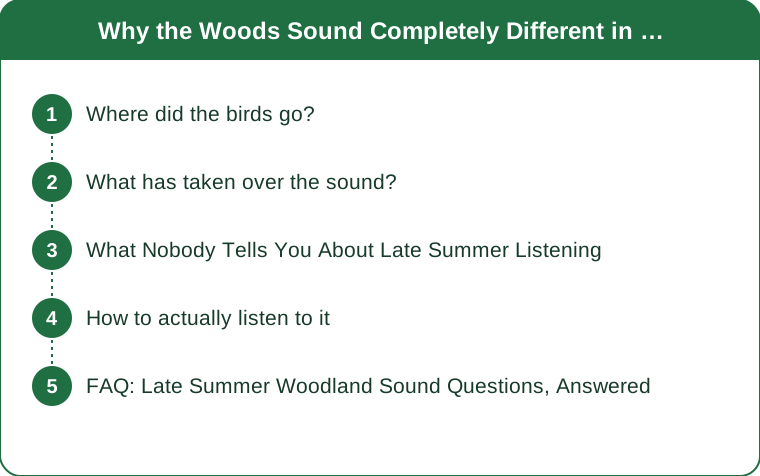
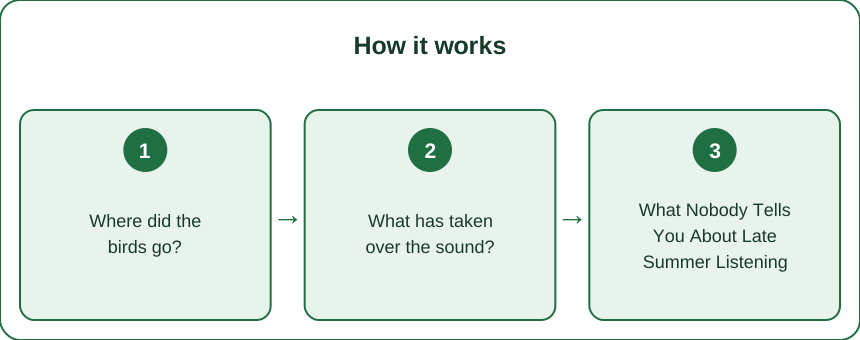
Where did the birds go?
Mostly nowhere. They are still there and they have stopped singing.
Song is primarily about territory and mating. Male songbirds sing to defend territory and attract mates, and by late July both jobs are done for the season. Broods have fledged, territories no longer need defending, and the biological reason for song has gone until next spring.
Many species moult right after breeding. Replacing an entire set of feathers is metabolically expensive and leaves birds temporarily less capable in flight, so moulting birds tend to become secretive - staying in dense cover, moving less, and calling minimally. A woodland can hold as many birds in August as it did in May and sound almost empty.
Calls replace songs. What you do hear now are contact calls - short, simple sounds used to keep flocks together or signal alarm. Chickadees, nuthatches, and jays remain audible for exactly this reason, and mixed feeding flocks start forming in late summer, which produces bursts of activity separated by long silences.
Migration begins earlier than most people think. Some species start moving south in July and August, well before the leaves turn. What you may be hearing on an August evening is nocturnal migration - thin, high call notes from birds passing overhead in the dark.
And the dawn chorus is essentially over. The overwhelming pre-dawn sound of May and June has thinned to a handful of species, which changes early morning walks more than any other time of day.
What has taken over the sound?
Insects, and the change in character is as important as the change in volume.
Orthopterans peak in late summer. Crickets, katydids, and grasshoppers hatch in spring and take months to reach adult size, so their peak abundance and peak sound production arrives in August and September. This is why the sound of late summer is fundamentally an insect sound.
The pattern is continuous rather than intermittent. Bird song is punctuated - a phrase, a pause, a phrase. Insect stridulation is close to continuous, produced by many individuals at once. That difference in texture is a large part of why the woods feel different even when overall volume is similar. A continuous sound recedes into background awareness; an intermittent one keeps drawing attention.
Temperature controls the rate directly. Cricket chirp rate rises and falls with temperature closely enough that it can be used as a rough thermometer - the traditional method of counting chirps in a set interval and adding a constant is genuinely approximately accurate for some species. Which means the woods literally sound cooler on a cool evening.
Cicadas dominate the daytime in many regions, with a very different sound - loud, buzzing, produced by a specialised organ rather than by rubbing body parts together, and typically most active in the hottest part of the afternoon.
And the timing shifts through the day. August woods have a clear acoustic schedule: quiet dawn, cicadas in the afternoon heat, and a crescendo of crickets and katydids from dusk into the night. The evening walk is now the loudest one of the day, which is a reversal of spring.

What Nobody Tells You About Late Summer Listening
The leaves themselves have changed pitch. Young spring leaves are soft, thin, and full of water, and they move against each other quietly. By late August leaves are mature, drier, and stiffer, and they produce a noticeably crisper, higher rustle in the same wind. This is the change people notice most and identify least, because nobody expects the trees to have a different sound.
The canopy is at its densest, which changes acoustics. Full leaf cover absorbs and scatters higher frequencies, which is why woods in full leaf sound more muffled and enclosed than the same woods in winter. Sound does not travel as far, and distant noise from roads or towns is more thoroughly filtered.
Understory sounds increase. Small mammals are active and abundant after a season of breeding, and dry leaf litter on the ground amplifies their movement dramatically. The rustle you keep hearing beside the path is real, and there is far more of it now than in June.
Water sounds are at their annual minimum. Streams are at their lowest flow after a summer of evaporation, so the water component of the soundscape is quieter than at any other time of year. In woods with a stream, this alone changes the character considerably.
And the quiet is a feature, not a loss. The absence of bird song makes the smaller sounds audible - a leaf falling, an insect landing, wind moving through a single branch. Late summer is arguably the best listening of the year for anyone interested in the quieter layers, because the loudest layer has stepped aside.
One practical note: this is the last window of full-canopy woodland before the leaves start dropping, and once they do, everything about the acoustics changes again within about three weeks.
How to actually listen to it
Stand still for a minimum of three minutes. This is the whole technique and it is harder than it sounds. Sound layers reveal themselves in sequence - the loud continuous layer first, then the intermittent middle layer, then the very quiet layer of individual small events. Most people move on before the third layer arrives, and the third layer is the interesting one.
Close your eyes. Visual attention dominates, and removing it genuinely improves auditory discrimination. Thirty seconds with eyes closed is not the same as thirty seconds looking around.
Try cupping your hands behind your ears. It sounds ridiculous and it works - it increases the effective collecting area and directionality noticeably. Two seconds of trying it settles the question.
Go at dusk, which is now the loudest time. The transition from cicada afternoon to cricket evening happens over about forty minutes around sunset, and sitting through it is one of the more striking natural transitions available at this time of year. Late August sunset is early enough to do this and be home in daylight.
Pick one sound and follow it. Rather than taking in everything, choose a single cricket or a single call and track it for a minute. This is a standard attention practice and it is far more absorbing than passive listening.
And do it in the same place repeatedly. The value of a regular spot is that change becomes visible - or audible. Someone who visits the same hundred metres of path weekly through September will hear the insect layer thin and the migration calls appear, which is a completely different experience from noticing that things sound different.
Practical: bring a layer. Standing still for fifteen minutes at dusk in late August is meaningfully cooler than walking, and being cold is the most common reason people cut it short.
FAQ: Late Summer Woodland Sound Questions, Answered
Why do birds stop singing in late summer?
Because song is primarily about defending territory and attracting mates, and both are finished once breeding season ends in July. Many species also moult right afterward, which is metabolically demanding and makes them secretive. The birds are still present - they have simply stopped doing the thing that made them audible.
What are the loud insects in late summer?
Crickets and katydids in the evening and at night, and cicadas during the hottest part of the afternoon. They hatch in spring and take months to reach adult size, so late August and September is when their abundance and sound production peak.
Can you tell the temperature from cricket chirps?
Approximately, yes. Chirp rate rises predictably with temperature in several species, and the traditional method of counting chirps over a set interval and adding a constant gives a rough estimate. It is a real relationship rather than folklore, though accuracy varies by species.
When is the best time to listen in the woods in late summer?
Dusk. The transition from the afternoon cicada sound to the evening cricket and katydid chorus happens over about forty minutes around sunset, and it is the most dramatic acoustic change available at this time of year. Bring a layer - standing still gets cold faster than walking.
TL;DR:
- Songbirds stop singing in July because breeding is over and many are moulting.
- Crickets, katydids, and cicadas peak now, and their sound is continuous rather than punctuated.
- Mature leaves rustle at a higher pitch than soft spring ones - the change nobody identifies.
- Full canopy muffles distant sound; streams are at their annual low.
- Stand still three minutes, eyes closed, at dusk. The third layer is the interesting one.
The path did not change. The loudest thing on it stopped, and everything quieter got its turn.
Keep Reading
This article is for general informational purposes only and is not medical advice. Always consult a qualified health professional for guidance specific to you.