Why the Woods Feel Completely Different in the First Weeks of Leaf Fall
Quick Answer: Three sensory channels change simultaneously in early leaf fall. Light increases and becomes lower-angled as the canopy thins, so the forest floor is brighter and more contrasted than at any point since spring. Sound changes character - the canopy that absorbed high frequencies is thinning, and the leaf litter underfoot adds a constant textural layer. And smell shifts sharply toward the earthy compounds of decomposition. The practice adapts easily: slow down more, use the ground as the focus rather than the canopy, and go later in the day to use the low light.
You have walked this path all summer. This week it is unrecognisable, and you would struggle to say exactly why.
The trees are still there. Most of the leaves are still on them. But the light is coming through differently, your footsteps sound completely different, and the air smells like something else entirely.
Early leaf fall changes more sensory channels at once than any other point in the woodland year, which is exactly why it is worth being there for.
What actually changes in the light?
More of it reaches the floor, and it arrives at a lower angle - both at once.
A summer canopy blocks a very large proportion of incoming light. As leaves thin and gaps open, the amount reaching the forest floor rises substantially over a few weeks.
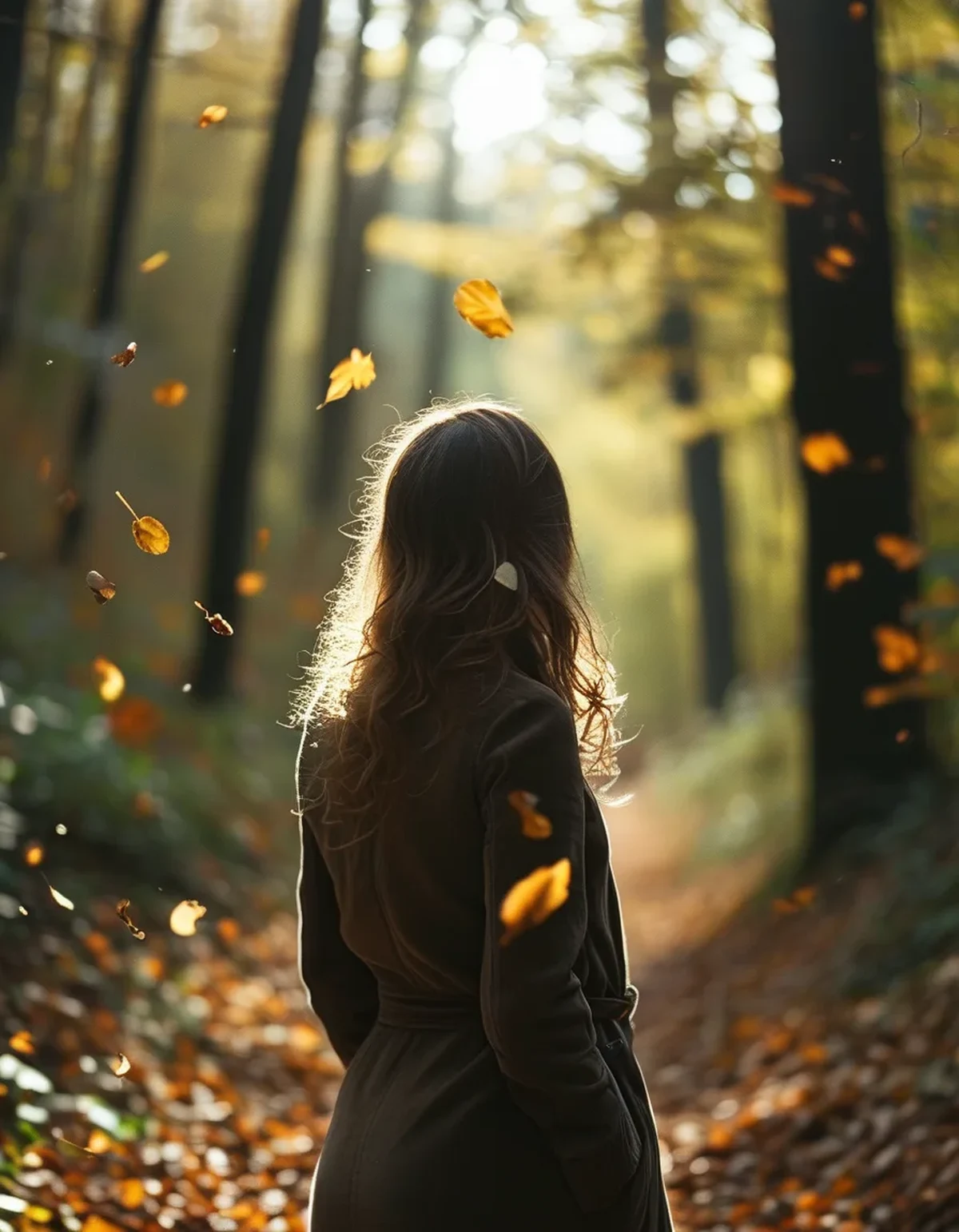
At the same time, the sun sits lower in the sky, which means light comes through the trees more horizontally rather than from overhead. Horizontal light travels through more foliage, creates longer shadows, and produces the distinctive shafts and beams that people associate with autumn woodland.
The colour of the light changes too. Light filtered through green leaves is tinted green. Light filtered through yellowing and browning leaves carries a warmer cast, and light passing through gaps is unfiltered daylight. The result is a much more varied light environment than summer’s fairly uniform green shade.
And the contrast rises sharply. Summer woodland is evenly dim. Early autumn woodland has bright patches and deep shade next to each other, which is visually far more dynamic - and genuinely more demanding for the eyes, since they are constantly adapting.
Practically, this changes what is worth looking at. In summer, the canopy is the visual event. In early autumn, the forest floor is the most interesting place - it is lit for the first time since spring, the leaf litter has texture and colour, and things growing at ground level are suddenly visible.
The time of day matters more than it did. Low-angle light in the last two hours before sunset produces the most dramatic conditions, and the window is short - and getting shorter by two to three minutes a day.
Why does it sound so different?
Because the canopy that was absorbing sound is thinning, and the ground that was absorbing footsteps is now amplifying them.
Foliage absorbs high frequencies effectively. A full summer canopy dampens birdsong, distant traffic and the general high-frequency hiss of the environment. As leaves fall, that absorption drops and the acoustic character opens up - sounds carry further and arrive brighter.
Distant sound intrudes more. A road that was inaudible in July can be clearly present in October from the same spot. This is one of the more disappointing autumn discoveries for people who use a particular woodland for quiet, and it is entirely a foliage effect.
The ground changes completely. Dry leaf litter is loud - each footstep produces a distinctive crunch that is impossible to avoid. This makes moving quietly essentially impossible, which changes both the experience and the wildlife you will see.
Wet leaf litter is the opposite - it is one of the quietest surfaces there is, absorbing sound almost completely. So the woods after rain in autumn are dramatically quieter than the same woods on a dry day, which is a much bigger difference than the equivalent in summer.
Birdsong drops away. The breeding season is over, so territorial song has largely stopped. What remains is contact calls, alarm calls and the sound of birds moving - much quieter, much more intermittent. The woods genuinely are quieter in terms of birds, which surprises people who expect autumn to be busy.
And a new sound appears: leaves falling. In still conditions, individual leaves detaching and landing is audible, and it is one of the most distinctive sounds of the season.

What Nobody Tells You About Autumn Forest Practice
The smell change is the largest and the least discussed. Decomposition ramps up as leaf litter accumulates and moisture rises. The characteristic earthy smell comes largely from geosmin, a compound produced by soil bacteria, and humans are extraordinarily sensitive to it - detectable at a few parts per trillion. That smell is the single most evocative marker of autumn woodland, and it is at its strongest in the first weeks of leaf fall when the litter is fresh and wet.
Fungi appear, and they change what there is to notice. Autumn is the fruiting season for most fungi, and a path that had nothing in July has dozens of species in October. This is genuinely the best time of year for close, slow looking at ground level. Look, do not pick - identification is genuinely difficult and the consequences of getting it wrong are severe.
Wet leaves are extremely slippery, particularly on slopes and roots. This is a real hazard rather than a caution - the friction on a wet leaf-covered root is close to zero. Footwear with genuine tread matters from now until the litter breaks down.
The temperature under the trees diverges more from open ground. Woodland is buffered - cooler in summer, and in autumn it holds warmth slightly longer in the evening while being noticeably damper. You will feel colder than the air temperature suggests because of the humidity and the lack of sun.
Insects drop away sharply, which changes the experience for the better. The midges, mosquitoes and flies that made summer sitting practice difficult are largely gone. Early autumn is the best sitting season of the year for exactly this reason, and it is rarely mentioned.
And the light window is closing fast. Losing two to three minutes of daylight per day means an after-work walk that finished in light two weeks ago finishes in dusk now. This is worth planning around rather than discovering.
How should the practice change?
Slower, lower, later - and shorter is fine.
Slow down more than usual. Autumn woodland rewards close looking - fungi, leaf detail, the texture of the litter, the changing colours. These are small-scale things that a normal walking pace passes entirely. Halving your pace roughly doubles what you notice, and in autumn there is more to notice at ground level than at any other time.
Shift the focus to the floor. Summer practice tends to look up and out - the canopy, the light through leaves, the space. Autumn practice works better looking down. The floor is lit, textured and full of change.
Go later in the day. The low-angle light in the final two hours before sunset is the most striking condition of the year, and the window shrinks by two to three minutes a day. This is the period to prioritise, and it will not be available for long.
Sit more than you walk. With the insects gone and the ground interesting, sitting practice is more rewarding now than at any other point in the year. Bring something waterproof to sit on - the ground is genuinely wet.
Use smell deliberately. It is the most changed sense and the most neglected in practice. Stop, close your eyes, and breathe for thirty seconds somewhere with deep leaf litter. It is the most direct sensory access to the season available.
Go after rain, not just on dry days. Wet leaf litter is quieter, smells far stronger, and the colours are more saturated. Most people avoid the woods after rain, which means it is also emptier.
And keep the sessions short if that is what fits. Twenty minutes in the right light is worth more than an hour at midday, and as the evenings contract, twenty minutes is often what is available. That is enough.
FAQ: Autumn Forest Bathing Questions, Answered
Is autumn a better time for this than summer?
Different rather than better, though many people find it richer. There is more sensory change to notice, the insects are gone, the light is more dramatic, and the smell is at its most distinctive. What you lose is the greenness, the birdsong, and the long comfortable evenings. The practical advantage is that autumn gives you more to pay attention to, which makes slow attention easier.
What about the shorter days?
Plan around them rather than fighting them - and check sunset times, because they are moving fast at this point in the year. The best light is in the last two hours before sunset, so a twenty-minute session at the right time beats an hour at midday. If your only available window is after dark, a familiar path with a torch is a genuinely different and worthwhile practice, though it needs a route you know well.
Is it safe to walk on wet leaves?
On flat ground, yes, with reasonable footwear. On slopes, steps and tree roots, wet leaves are one of the most slippery surfaces you will encounter - friction drops close to zero, and this causes a lot of autumn falls. Shoes with genuine tread, and slowing down on any descent, addresses most of it.
TL;DR:
- Three channels change at once: more light at a lower angle, sound opening up as the canopy thins, and the earthy smell of decomposition at its strongest.
- The forest floor is the event now - lit for the first time since spring, textured, and full of fungi.
- Wet leaf litter is the quietest surface there is and smells far stronger. Go after rain, not just on dry days.
- The insects are gone, which makes this the best sitting season of the year.
- Go in the last two hours before sunset - and check the time, because daylight is contracting two to three minutes a day.
Wet leaves on roots and slopes are genuinely slippery. Tread on the shoes, and slow down going downhill.
Keep Reading
This article is for general informational purposes only and is not medical advice. Always consult a qualified health professional for guidance specific to you.