Forest Bathing When You Cannot Switch Your Brain Off
Quick Answer: Stop trying to empty your head - that instruction makes rumination worse, not better. Instead give your attention a specific external task it cannot do while also running a loop: count five distinct sounds, name three shades of green, or walk at half your normal speed and notice each foot landing. The physiological benefits of being in a forest - lower cortisol, lower blood pressure, shifted nervous system state - do not require a quiet mind to happen. They happen because you are there.
This is the most common reason people conclude forest bathing is not for them. They go, they think about work for forty minutes, and they decide they are doing it wrong. They are not.

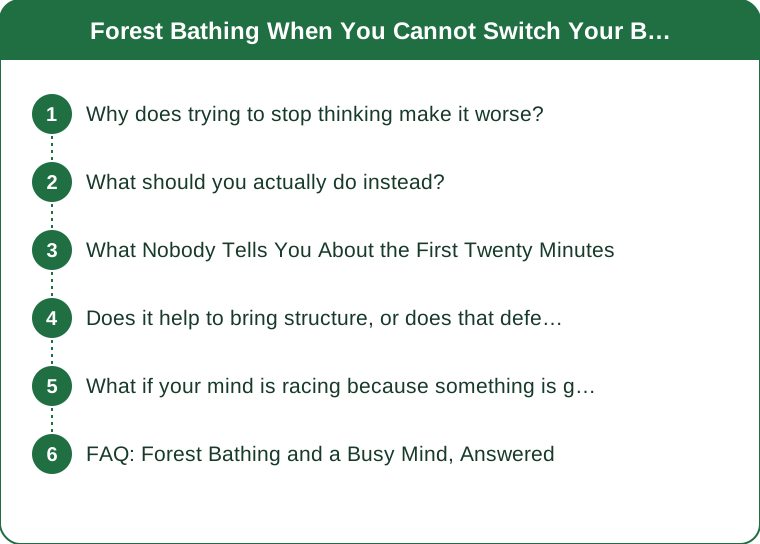
Why does trying to stop thinking make it worse?
Because suppression is an active mental task, and active mental tasks keep the loop running.
The well-documented finding is that deliberately trying not to think about something increases how often it comes to mind. The monitoring process - checking whether you have stopped thinking about it - requires holding the thing in mind. You cannot check for it without invoking it.
So the instruction to clear your mind sets up a losing structure: think, notice you are thinking, try to stop, check whether you stopped, and in checking, think again.
Rumination has a second property that matters here. It is self-reinforcing and it is largely internally directed - attention pointed inward at your own thoughts. The reliable way out is not to reduce thinking; it is to redirect attention outward at something specific enough to occupy it.
This is precisely what the research on nature and rumination points at. Walking in a natural environment is associated with reduced rumination and reduced activity in brain regions linked to it - and notably, the effect does not depend on the walker successfully meditating. The environment is doing work that your effort is not required for.
What should you actually do instead?
Give attention a job. Five options, all of which work, none of which require you to feel calm.
Count five distinct sounds. Not categories - individual sounds. One bird, then a different bird, then wind in a specific tree, then something moving in leaf litter, then something distant. This is genuinely hard, which is the point.
Name three shades of green. Then find a fourth. Colour discrimination occupies a different part of attention than verbal rumination and it competes with it directly.
Walk at half speed. Deliberately, for five minutes. Slow walking requires balance attention and it is almost impossible to do while fully absorbed in a thought loop - you will notice yourself speeding up whenever the loop takes over, which makes the pace a live feedback signal.
Find five things at different distances. Something at arm’s length, something at ten metres, something at fifty, something at the canopy, something at the horizon. Shifting focal distance repeatedly is physically incompatible with the fixed middle-distance stare of rumination.
Touch three different textures. Bark, moss, a leaf. Tactile input is the hardest sense to think over.
Pick one. Do it for four minutes. Not the whole session - the shift usually happens well before then.
What Nobody Tells You About the First Twenty Minutes
The first stretch is supposed to be busy, and knowing that changes the whole experience.
When you stop moving through a stimulating environment and enter a quiet one, the internal noise gets louder relative to the surroundings. Nothing has increased; the background has dropped. This is why the first ten minutes in the woods often feel worse than the car journey there.
Most people interpret this as evidence of failure and either leave or spend the rest of the session frustrated.
What the research on session length suggests: the physiological markers - cortisol, blood pressure, heart rate variability - shift over 20 to 30 minutes in a forest environment. That is roughly the same window in which people report their thinking starting to settle. The settling is downstream of the physiology, not a prerequisite for it.
The practical implication is a promise worth making to yourself: commit to staying thirty minutes regardless of how the first ten feel. Not to enjoying it, not to being present - just to staying. Most people find the shift arrives somewhere in the second half, and it arrives whether or not they were doing it right.
And if it does not arrive that day, the cortisol change happened anyway.

Does it help to bring structure, or does that defeat the point?
Structure helps, and the purist version of this practice is the one most likely to get abandoned.
A route helps. Deciding where you are going removes a small ongoing decision load. Wandering sounds better in theory and in practice it adds a background task.
A time limit helps. Thirty minutes, decided in advance, with a phone in a pocket on silent. Open-ended sessions produce clock-checking, which is its own loop.
A single question helps some people enormously. Carry one open question into the woods - not a problem to solve, a question to hold. What is actually bothering me about this? rather than what should I do about this? The first is compatible with walking; the second is a work task and it will absorb the whole session.
A notebook at the end, not during. Five minutes sitting at the end, writing whatever surfaced. This is where a lot of the value lands for people who think in words, and doing it at the end rather than throughout keeps the walk itself unstructured.
What genuinely does not help: guided audio for most people who struggle with rumination specifically. It adds a voice to a head that already has too many, and the instruction to notice your thoughts is exactly the monitoring loop described above.
What if your mind is racing because something is genuinely wrong?
Then the woods are a useful place to be and a bad place to expect a solution, and the distinction matters.
Forest bathing is not a substitute for addressing a real problem. If you are ruminating about a deadline, a diagnosis, or a relationship, the loop is doing something - inadequately, repetitively, but it is pointed at a genuine thing. Expecting a walk to dissolve it sets up a disappointment.
What it does do reliably: lowers physiological arousal, which changes the quality of the thinking rather than stopping it. People consistently report that the same problem feels smaller and more tractable after time outdoors, and that is a real and useful effect even when nothing has been resolved.
A structure that works for this specific case: walk for twenty minutes with a sensory task, then sit for ten and let the thing come back deliberately. You will usually find it arrives in a different shape.
And a boundary worth naming: if intrusive thinking is persistent, disrupts sleep, or comes with low mood that has lasted weeks, that is worth talking to a doctor or a therapist about rather than walking off. Time outdoors supports mental health genuinely well and it is not a treatment for depression or an anxiety disorder.
This is general information, not medical advice.
FAQ: Forest Bathing and a Busy Mind, Answered
How long before I should expect anything to change?
Within a single session, twenty to thirty minutes. Across weeks, most people report the first ten minutes getting easier after four or five outings - familiarity with the place does a lot of the work.
Does it have to be a real forest?
No. Effects are found in parks and smaller green spaces too, generally smaller than in dense woodland. Whatever you will actually go to twice a week beats the perfect forest you visit twice a year.
Is it better alone or with someone?
For rumination specifically, alone or with someone who is comfortable with silence. Conversation is an excellent distraction and a poor substitute for the effect described here.
What if I only have fifteen minutes?
Take it. The full physiological shift wants longer, but shorter exposures still register, and a fifteen-minute habit is worth more than a two-hour intention.
TL;DR:
- Trying to stop thinking makes it worse - the monitoring loop keeps the thought alive.
- Give attention an external task: five sounds, three greens, half-speed walking, five distances, three textures.
- The first ten minutes are supposed to feel loud. Commit to thirty minutes regardless.
- The physiological benefits do not require a quiet mind - they happen because you are there.
- Structure helps: a route, a time limit, one question, and a notebook at the end rather than during.
Nobody arrives in the woods and switches off. The people who get the most from this are the ones who stopped expecting to.
Keep Reading
This article is for general informational purposes only and is not medical advice. Always consult a qualified health professional for guidance specific to you.