What Changes in the Woods in the Last Weeks of Summer
Quick Answer: Late August is the quietest and densest point of the forest year. Birdsong drops off sharply because breeding season is over, the canopy is at maximum thickness so the light is at its dimmest and greenest, insect sound peaks and then falls with the first cool nights, and the smell shifts from green growth toward fungal decay. Most people wait for autumn colour and miss the more interesting transition happening now.
If you have a regular walk, this is the fortnight where it changes most and looks least different.
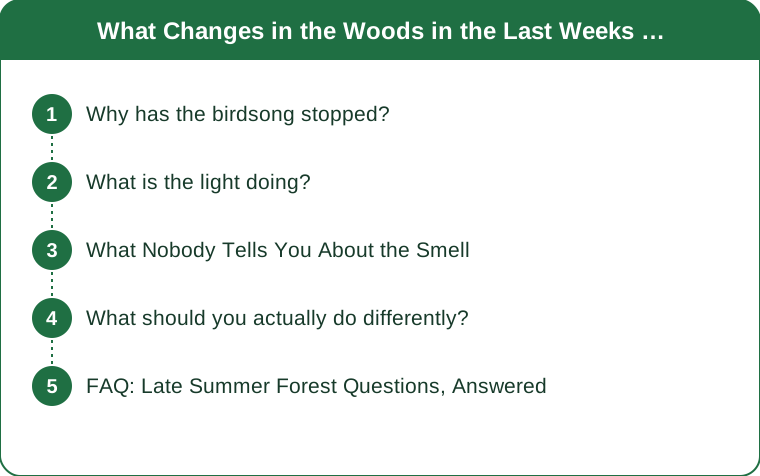
Why has the birdsong stopped?
Because it was never background music - it was territorial and mating behaviour, and that season has ended.
Spring birdsong is functional. Males sing to establish territory and attract mates, and the dawn chorus in May is an extraordinarily dense competitive display. Once breeding is finished and young have fledged, the function disappears and so does the song.
By late August most species have largely stopped singing. What remains is call notes rather than song - short contact calls, alarm calls, and the sounds of family groups moving together. It is a quieter, more scattered soundscape.
There is a second reason for the quiet: moult. Many birds replace their feathers after breeding, which is energetically expensive and makes them temporarily less capable fliers. Moulting birds are noticeably more secretive - they stay in cover, move less, and draw less attention to themselves. So the woods are not only quieter, they genuinely contain fewer visible birds than a month ago even though the population is at its annual peak after the breeding season.
What to listen for instead:
- Mixed feeding flocks starting to form - different species moving through the canopy together, which is a distinctly autumn behaviour and is beginning now.
- Migration overhead, particularly at night. Late August is the start of serious southbound migration for many songbirds.
- The absence itself. A forest without a chorus is a different acoustic space, and if you have been walking the same route since spring, this is the most striking change of the year.
What is the light doing?
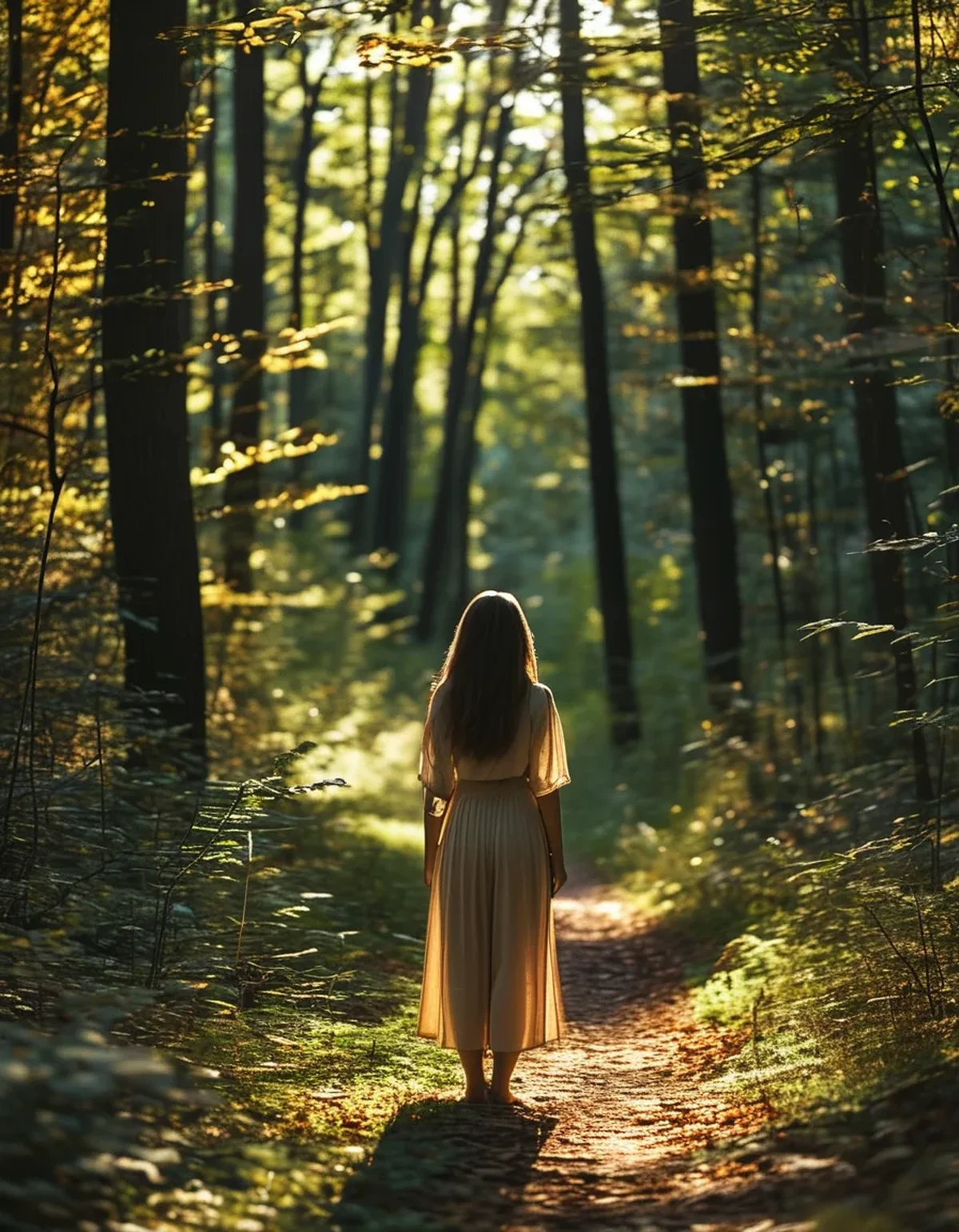
It is at its dimmest and most green, and this is the peak of an effect that will reverse quickly.
The canopy reaches maximum leaf area in late summer. Every leaf that will grow this year has grown, and none have yet fallen. Light reaching the forest floor is at its annual minimum - in a dense deciduous forest, often only a small percentage of what is available above the canopy.
That light is also spectrally shifted. Leaves absorb red and blue wavelengths for photosynthesis and transmit and reflect green, so light that has passed through the canopy is strongly green-biased. This is why late summer woodland feels submerged in a way that spring woodland does not - in spring the canopy is thin and the light on the floor is closer to full-spectrum.
Two things worth noticing on a walk right now:
- Sunflecks. The small moving patches of direct sun that penetrate gaps in the canopy. They are a significant proportion of the total energy reaching the forest floor, and they move visibly as the wind shifts the canopy. Watching them is one of the more absorbing things available in a late-summer wood.
- The angle. The sun is meaningfully lower than at solstice, so light comes through the canopy edge at a shallower angle. Path edges and clearings are lit differently than they were in June, and late-afternoon light in particular is noticeably more horizontal and golden.
This is also the last fortnight of it. Once leaves begin to thin, the floor gets brighter quickly, and by mid-October it will be receiving several times more light than it does today.

What Nobody Tells You About the Smell
The forest smells different in late August than at any other point in the year, and it is the beginning of a shift that runs all the way to winter.
Through spring and early summer, forest smell is dominated by green volatiles - compounds released by growing leaves and cut vegetation, including the green leaf volatiles responsible for the smell of fresh grass. Plus flowering, resin from conifers, and damp soil.
By late August, growth has largely stopped and decomposition is at its peak. Soil temperature is at its annual maximum, moisture is often high after summer rain, and there is a full season’s worth of dropped material on the floor. Fungal and bacterial activity in the leaf litter is running at its fastest rate of the year.
What that produces is a distinctly earthy, mushroomy smell that people associate with autumn but which actually begins now. Much of it comes from geosmin, a compound produced by soil bacteria - the same compound responsible for the smell of rain on dry ground. Humans are remarkably sensitive to it, detecting it at concentrations of a few parts per trillion.
There is also the phytoncide dimension, which is the mechanism most often cited in forest bathing research. These are antimicrobial volatile compounds released by trees, particularly conifers, and their release is temperature-dependent - meaning warm late-summer days produce among the highest concentrations of the year. Studies on forest bathing have associated phytoncide exposure with reduced stress markers and changes in immune cell activity, though the research base is still developing.
The practical suggestion: on your next walk, spend two minutes with your eyes closed, breathing through your nose. Late August rewards this more than any other month, and it is the sense most people never deliberately use in a forest.
What should you actually do differently?
Four adjustments that suit what the forest is doing right now.
Go later in the day. The best light is late afternoon into early evening, when the low angle produces long sunflecks and warm colour at the canopy edge. It is also when the temperature is dropping and insect sound is at its most active. Sunset is arriving noticeably earlier now than a month ago, so a 6pm walk that felt like mid-afternoon in June feels like evening.
Slow down and use hearing deliberately. With birdsong reduced, the remaining soundscape is subtler - insects, leaves, water, distant calls. This is the month where a sit spot works best, because there is less obvious activity and more that only appears if you stay still. Fifteen minutes seated is worth more than an hour walking right now.
Look down. Fungi are beginning. Late August after rain is the start of the mushroom season, and the forest floor is where the visible change is happening while the canopy still looks like summer. Do not pick anything without expert knowledge - many species are dangerous and look ordinary.
Notice the edges. Woodland edges and clearings are where late-summer activity concentrates - berries ripening, insects, and birds feeding before migration. The interior of a dense wood in late August is comparatively quiet and dark; the edges are where it is happening.
One practical note: late August is peak tick season in much of the US and mosquitoes are still active around water. Long trousers, a check afterward, and awareness of where ticks are prevalent locally is straightforward sense rather than excessive caution.
FAQ: Late Summer Forest Questions, Answered
Is late summer a bad time to start forest bathing?
No - arguably one of the better times. Phytoncide concentrations are high on warm days, the weather is reliable, and the reduced birdsong actually helps a beginner, because there is less to identify and more incentive to simply be present. The main practical obstacles are insects and heat, both of which are managed by going late in the day.
Why do the woods feel more humid than open ground?
Because transpiration from a full canopy releases a great deal of water vapour, and the canopy traps it. A dense summer wood can be noticeably more humid than adjacent open ground, while also being several degrees cooler - which is why forest shade in August feels so different from building shade.
When will the actual autumn changes start?
Colour change is driven by shortening days and cool nights. In the northern US, the first colour typically appears in early to mid September, with peak varying by latitude and elevation from late September through late October. The changes described here run for the next two to three weeks and then hand over.
How long does a forest walk need to be to matter?
Research in this area commonly uses sessions in the range of 15 minutes to two hours, and benefits have been reported at the shorter end. Consistency appears to matter more than duration - a regular 20-minute walk is a reasonable target and is far more sustainable than an occasional long one.
TL;DR:
- Birdsong has largely stopped because breeding season ended and many birds are moulting and staying in cover.
- The canopy is at maximum density, so forest-floor light is at its annual minimum and strongly green-shifted.
- Decomposition peaks now, producing the earthy geosmin smell people associate with autumn but which starts in August.
- Phytoncide release is temperature-dependent, so warm late-summer days produce among the highest concentrations of the year.
- Go late in the day, sit still rather than walking, look down for early fungi, and pay attention to woodland edges.
This is the fortnight the forest changes most and looks least different. Watch for ticks, and go before the light shifts.
Keep Reading
This article is for general informational purposes only and is not medical advice. Always consult a qualified health professional for guidance specific to you.