Rain on Leaves, Distant Birds: Using Nature Sound for Sleep and Focus
Quick Answer: Use steady, non-melodic nature sounds — rain, streams, wind in leaves — for focus, because they mask background noise without demanding attention. Use rain-on-tent or slow surf for sleep, on a 60-minute timer. Research consistently finds natural soundscapes reduce stress markers and support attention recovery better than urban noise.
You can’t go forest bathing at 2 a.m. You definitely can’t do it in the middle of a spreadsheet.
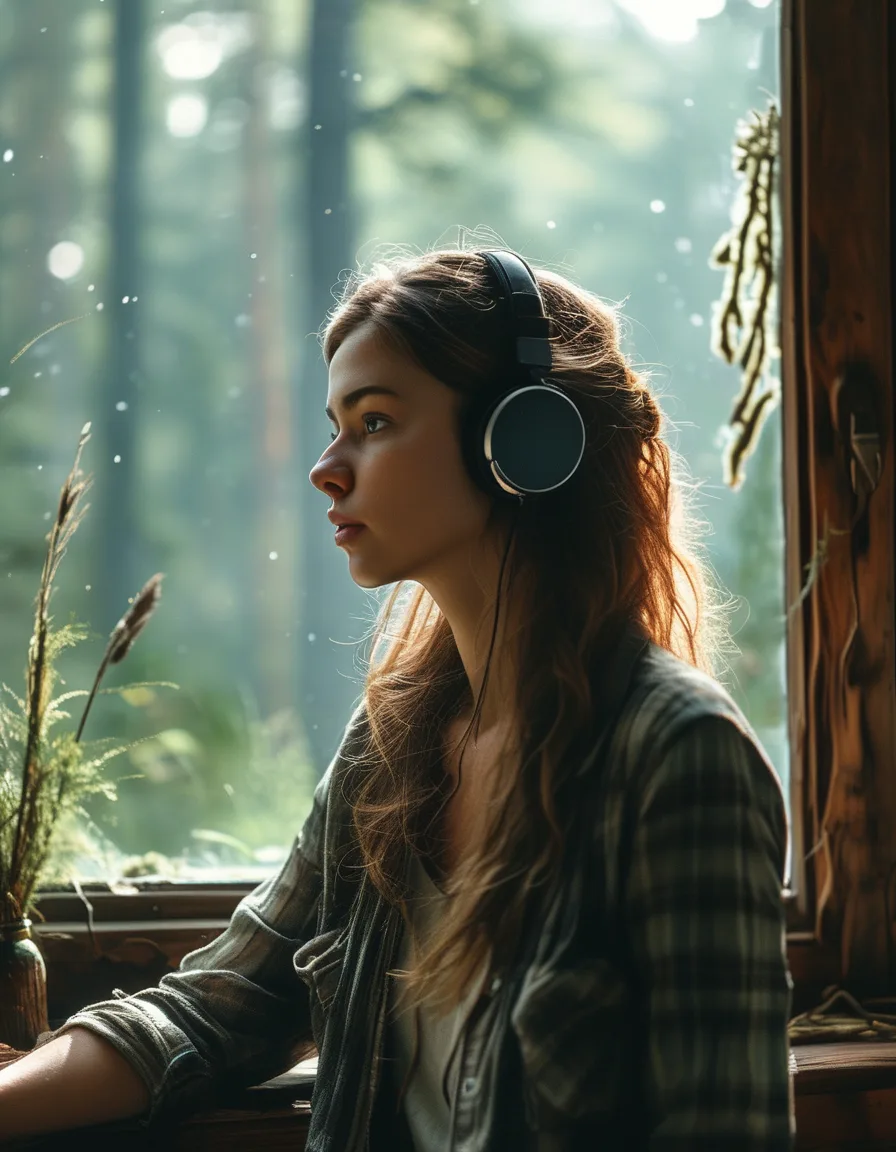
But the audio travels. And it turns out a decent chunk of what makes a forest calming survives the trip through a pair of headphones.
Not all of it. The real thing still wins. But at 2 a.m., partial is precisely enough.

Do nature sounds actually work, or is it placebo?
There’s a real effect, and it’s been measured repeatedly.
Studies comparing natural soundscapes to urban ones consistently find that nature audio is associated with lower physiological stress markers — things like reduced sympathetic nervous system activity — and with better recovery of directed attention after a demanding task. Urban noise, especially traffic and unpredictable human sound, tends to move those measures the other way.
The leading explanation is that natural sounds are read by the brain as safety signals. Steady rain, moving water, and distant birdsong are all sounds that historically indicated a non-threatening environment. Sudden, irregular, human-generated sound is the opposite.
Two honest caveats. First, recorded nature isn’t equivalent to being outdoors — you’re missing light, air, movement, and smell, all of which carry part of the effect. Partial is the accurate word. Second, individual response varies a lot, which is why the “best” soundscape is a personal question rather than a settled one.
Still: a partial dose available instantly through headphones at any hour is a genuinely good trade.
What nature sounds are best for focus and work?
Steady and non-melodic. That’s the whole selection rule.
The reliable options: rain (without thunder), a stream or river, wind through leaves, and distant surf. What these share is consistency — no sudden events, no melody, nothing your brain wants to track. They raise the noise floor enough to mask office chatter and hallway noise without recruiting attention themselves.
Birdsong is the divisive one. Some people find it cheerful and energizing; others hear individual soloists and get pulled out of their work every eight seconds. Test yours for a week before committing. If you like it, background birdsong layered under rain is usually the compromise that works.
Avoid for focus: thunderstorms with actual thunder (each crack is an event), crackling fires (irregular pops), and anything with wildlife calls. Also avoid anything with a musical layer — “nature-inspired ambient music” is music, and music with structure competes for the same attention you’re trying to protect.
Volume matters more than people expect. Set it just loud enough to blur the noise you’re masking, no louder. If you can clearly pick out individual raindrops, it’s too loud.

What should I play to fall asleep?
Rain-on-tent and slow surf are the two night classics, and both earn it for the same two reasons.
They mask noise spikes. Apartment living means a slammed door at 12:40 and a car alarm at 3. A continuous sound floor means those spikes are smaller relative to the background, so they’re less likely to wake you. That’s the same principle white noise machines use — nature audio just does it more pleasantly.
They carry an association. Rain on a tent means camping. Surf means a beach at night. Those memories come with a body state attached, and the sound retrieves it.
Practical setup:
- Set a 60-minute timer. You’ll be asleep well before it ends, and the brain keeps the calm after the speaker stops. Playing it all night can lighten sleep in some people.
- Keep the volume low — around the level of a quiet fan.
- Use the same track most nights. Consistency builds the conditioned response faster than variety does.
- Skip anything with thunder or animal calls. Same reason as focus, doubled.

How do I make the audio work better over time?
Charge the association with a real walk.
Here’s the trick almost nobody uses: play the same soundscape during actual outdoor time — a park lunch, a walk in light rain, an hour in the garden. Do it three or four times. You’re deliberately pairing the recording with the genuine experience.
After that, the audio isn’t just pleasant sound anymore; it’s a retrieval cue for a state your body has actually been in. Conditioned associations are why a specific song can drop you into a specific mood in two seconds, and the same mechanism works here on purpose.
The recording works better once it has a memory attached. Free upgrade. Cost: one walk.
The same logic applies in reverse — if you use your sleep track while doomscrolling in bed, you’re pairing it with alertness and slowly training it into uselessness. Keep the sleep sound for sleep.
5 Mistakes Everyone Makes With Nature Sound
- Playing it too loud. Masking works at low volume. Loud audio becomes its own stimulus.
- Choosing melodic “nature music.” If it has chords, it’s competing with your work.
- Switching tracks constantly. Novelty is the enemy of conditioning. Pick one for focus, one for sleep, and be boring about it.
- Running it all night at full volume. A 60-minute timer is enough, and continuous audio can fragment deep sleep for some people.
- Using the sleep sound during the day. The one that quietly ruins the whole system — you’re diluting the association you spent weeks building.
FAQ
Are nature sounds better than white noise for sleep?
For most people, yes, though the difference is modest. Both mask noise spikes equally well, but nature sounds are generally rated as more pleasant and carry positive associations that pure white noise doesn’t. If you find rain distracting, though, white noise is a perfectly good alternative — the masking is the mechanism, and the pleasantness is a bonus.
Do nature sounds actually help you concentrate?
They help mainly by masking distracting noise and by supporting attention recovery between tasks. They’re not a nootropic. If your workspace is already quiet, the benefit is smaller. If you work in an open office or a café, the effect can be substantial.
What’s the best nature sound for anxiety?
Steady water sounds — rain and slow surf — are the most commonly reported. Try 10–15 minutes with your eyes closed and slow breathing rather than using it as background; the combination does more than the audio alone. If anxiety is persistent, interferes with daily life, or comes with physical symptoms, that’s worth raising with a physician or therapist rather than managing with audio alone.
Should I use headphones or a speaker?
A speaker for sleep — headphones are uncomfortable to sleep in and can irritate the ear canal over hours. Headphones for focus, because masking works far better when the sound is close to your ears. Over-ear beats earbuds for this.
TL;DR:
- Natural soundscapes measurably lower stress markers and aid attention recovery vs. urban noise
- Focus: steady, non-melodic — rain, streams, wind. No thunder, no melody, no wildlife calls
- Sleep: rain-on-tent or slow surf, 60-minute timer, low volume, same track nightly
- Keep the volume just above the noise you’re masking
- Charge the association by playing the same track during a few real outdoor sessions
- Don’t use your sleep sound during the day — it dilutes the cue
Rain for focus, surf for sleep, one real walk to charge the association. The portable forest is a partial dose with full convenience.
Keep Reading
This article is for general informational purposes only and is not medical advice. Always consult a qualified health professional for guidance specific to you.