Forest Bathing Without a Forest: Micro-Doses of Green That Still Count
Quick Answer: The core of forest bathing is slow, sensory, undirected attention in living surroundings - and studies keep finding meaningful effects far below wilderness dosage: measurable stress reduction from 20-minute city-park sits, mood benefits from the well-known 120-minutes-of-nature-per-week threshold met in fragments, and small but real responses to street trees, water features, even a window view. The city version is a practice of quality over acreage: one tree attended to fully beats a forest driven past. The lunch-break protocol takes 20 minutes, requires no equipment, and works in the park you already walk by.
The full prescription - a silent hour under old-growth canopy - is real and it is also three hours and a tank of gas away. Meanwhile the nervous system that needs it is at a desk on a Tuesday. The honest question is not whether the city version matches the mountain version. It is whether the available version works at all, and the research answer is a clear, qualified yes.
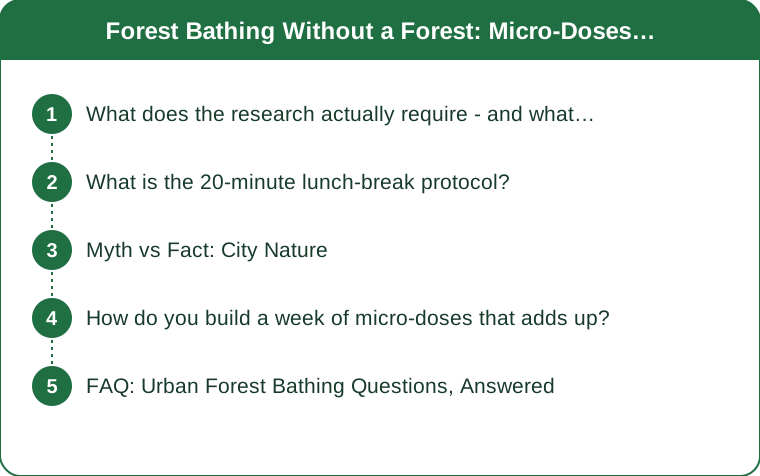
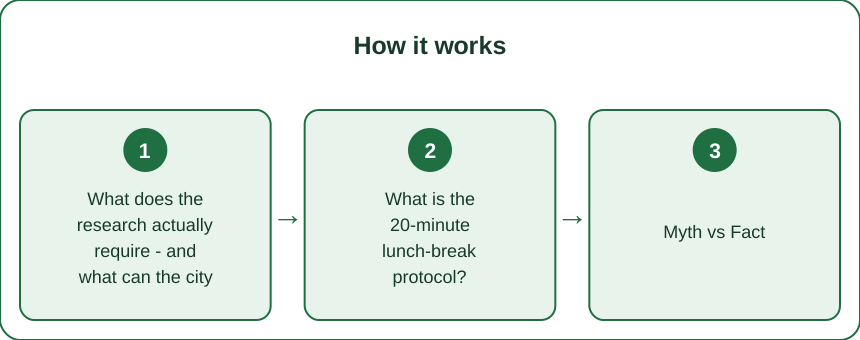
What does the research actually require - and what can the city deliver?
Less than the postcard suggests, on both counts.
The active ingredients are attention and environment, in that order. Forest bathing’s documented effects - lower cortisol, reduced blood pressure and heart rate, improved mood, restored attention - come from slow, receptive, sensory engagement with living surroundings. The practice is the walking-slowly-and-noticing part; the forest is the venue. Strip the attention away and the venue alone does much less: jogging through woods on a podcast is exercise with scenery, valuable but different.
The dose threshold is friendlier than expected. The widely cited finding on nature and wellbeing landed at about 120 minutes per week - associated with better self-reported health and wellbeing - and, crucially, it did not matter whether that time came in one long visit or many fragments. Twenty minutes, six days a week, in a decent park clears the bar. Other work has found significant drops in stress markers from as little as 20 to 30 minutes of sitting or strolling in urban green space.
Urban green counts on the record. Studies conducted in city parks - not wilderness - show real physiological responses. Street-tree density correlates with mental-health measures at the neighborhood level. Hospital patients with tree-view windows famously recovered faster than wall-view counterparts. The literature never gatekept for wilderness; the postcard did.
What the city genuinely cannot replicate: the deep quiet that lets hearing soften, the phytoncide-dense air of conifer forests studied in the immune-marker research, and the total absence of traffic-brain vigilance. The city dose is a real fraction - think of it as maintenance, with the occasional full-forest day as the deep clean. A fraction, taken daily, outperforms a whole postponed indefinitely.
What is the 20-minute lunch-break protocol?
A structure that turns an ordinary park into a practice. No equipment, no lotus position, no visible weirdness.
Minutes 0-3: arrive and downshift. Walk to the greenest fragment within reach - pocket park, courtyard with trees, riverside bench, even a generous median of mature canopy. Phone to do-not-disturb and into a pocket it does not leave. Walk the first minute deliberately at half your commuting pace; the slowing itself begins the shift, and it is the step city practitioners skip most.
Minutes 3-8: one sense at a time. Stand or sit and give each sense a full minute: everything you can hear beneath the traffic - there is almost always birdsong, leaf movement, water somewhere; everything moving in your vision - branches, light patches, insects; the air on skin and its temperature and smell; the ground’s texture through your shoes. Sequential beats simultaneous - it gives the attention somewhere specific to be, which is what crowds out the mental tabs.
Minutes 8-15: the slow wander or the one-tree sit. Either drift at a fraction of walking pace with no destination, letting whatever catches attention hold it - bark texture, an ant highway, canopy light - or choose one tree and actually study it: its structure, its movement in wind, its residents. Sounds simple; the observation depth available in one mature oak reliably shocks first-timers. In late August, the material is peak: full heavy canopy, loud insect chorus, the first hairline turns of color - arguably the year’s richest month for this exact practice.
Minutes 15-20: settle and return. Sit still, let all the senses run at once, and take five slow breaths - longer exhale than inhale, the one physiological lever that reliably nudges the nervous system parasympathetic. Then a normal-pace walk back. The transition minute matters: re-entering the office still half-downshifted is the whole point.
The consistency mechanics: same slot daily (calendar it like a meeting), same green fragment (familiarity deepens rather than bores - you start noticing change, which is its own reward), and a fallback indoor version for storm days, below.
Myth vs Fact: City Nature
Myth: If it is not wilderness, it is not doing anything. Fact: The measured effects show up in city parks, tree-lined streets, and gardens - reduced stress markers, improved mood and attention - at smaller magnitudes than deep forest but far above zero. The dose-response curve starts at the first tree, not at the trailhead.
Myth: Recorded nature sounds and plant videos are wellness theater. Fact: Weaker than the real thing, stronger than nothing, per a growing pile of studies: natural soundscapes measurably aid stress recovery, and even window views or nature imagery shift mood and attention modestly. The honest ranking - real multisensory nature, then real views, then recordings - argues for using each at its level, not dismissing the lower rungs.
Myth: Desk plants are decorative, not functional. Fact: Small but repeatable effects on comfort, attention, and stress appear in office-plant studies. A pothos is not a park. It is also not nothing, and it is present at 3pm on the day you cannot leave.
Myth: Green exercise must be exercise. Fact: Forest bathing is defined by slowness - the practice is closer to meditation than to hiking, and the standard beginner error is walking too fast. A stroll so slow it feels faintly ridiculous is the correct speed. Your runs in the park are excellent for other reasons; this is a different tool.
Myth: It requires silence and solitude to work. Fact: City practice happens over a traffic hum with other humans around, and the studies conducted in exactly those conditions still find effects. Attention is trainable around noise; the birdsong-beneath-the-buses is genuinely there once listening for it becomes habit. Headphones with nothing playing are the introvert’s legitimate privacy shield.
How do you build a week of micro-doses that adds up?
Stack the fragments; let the threshold assemble itself.
The daily anchor: the 20-minute protocol, five days a week - 100 minutes banked. Lunch is the classic slot; in an August heat wave, morning-commute-adjusted (leave 20 early, park-stop en route) beats the midday furnace and catches the day’s best air.
The commute upgrade: green routing. Most city routes have a tree-heavier alternative costing two to five minutes - the street with mature canopy, the cut through the square, the riverside block. Walked at even a slightly attentive pace, a green-routed commute is a real fractional dose, twice a day, for free. Route-choice is the single laziest effective intervention in this entire practice.
The micro-micro doses, for the unleavable days: two minutes at a window with sky and any tree in frame, attention fully out the glass; the desk-plant minute - actually looking at it, new leaf, soil, structure; a nature soundscape under noise-canceling for a focused block. Fractions of fractions - and the days that need them most are the days they are available.
The weekly deep dose: one 40-to-60-minute session in your city’s biggest green space - the arboretum, the large park’s interior where traffic fades, the botanical garden. This is where the city version gets closest to the full effect, and where the practice’s depth develops. Weekend morning, before the crowds, is the quality slot.
The seasonal note that makes now the time to start: a practice built in late August rides the year’s most dramatic material - the turn toward fall delivers visible weekly change to a practiced eye, which is the exact hook that converts a wellness experiment into a habit. The people who start in January face gray sticks for weeks; the people who start now get the whole show.
And hold the standard lightly. The metric is not mystical experience; it is the ordinary, reliable one - returning to the desk slightly slower-breathing than you left it. That, accumulated across a working year, is what the 120-minute research was measuring all along. The forest was never the only door in.
FAQ: Urban Forest Bathing Questions, Answered
Can you really forest bathe in a city?
Yes - the practice is slow sensory attention in living surroundings, and studies in urban parks and green streets show measurable stress, mood, and attention benefits. The effect is smaller than deep-forest sessions, but it starts at the first tree, and a daily 20-minute city practice outperforms the wilderness trip that keeps not happening.
How many minutes of nature per week actually help?
The most-cited threshold is about 120 minutes per week, associated with better health and wellbeing - and the research found it works accumulated in fragments as well as in one visit. Five 20-minute park breaks plus a green-routed commute clears it comfortably inside a normal work week.
What if there is no park near my office?
Work the hierarchy: any street with mature trees walked slowly and attentively, a courtyard or plaza with planting, a window with sky and canopy in frame, a desk plant given real attention, natural soundscapes on headphones. Each rung is weaker than the one above and stronger than nothing - and one weekly visit to the city’s biggest green space anchors the whole stack.
Is forest bathing just walking outside?
The venue overlaps; the mode does not. Forest bathing is markedly slow and receptive - senses open, destination none, pace far below a stroll - which is what distinguishes its effects from ordinary walking’s (also real, differently earned). The beginner’s checklist: phone away, half speed, one sense at a time, twenty minutes. The slowness is the technique.
TL;DR:
- The research requires attention in green surroundings, not wilderness - city parks and street trees produce measurable effects.
- The bar is about 120 minutes a week, and fragments count: five lunch-break sessions clears it.
- The 20-minute protocol: arrive slow, one sense per minute, wander or one-tree sit, settle, return.
- Stack lazy doses - green-routed commutes, window minutes, one weekly big-park hour.
- Start now: late August through fall is the year’s best show for a noticing practice.
The forest was the venue, never the mechanism. The mechanism fits in a lunch break, under the tree you have walked past two hundred times.
Keep Reading
This article is for general informational purposes only and is not medical advice. Always consult a qualified health professional for guidance specific to you.