Forest Bathing When the Woods Get Noisy With Wind
Quick Answer: Wind changes a forest from a quiet space into a loud, moving one, and most forest bathing guidance assumes stillness. It still works - often better for people who find silence uncomfortable - provided you change what you are attending to. Use the wind as the anchor rather than trying to hear past it, choose sheltered valley or dense-canopy locations over exposed ridges, and shorten the session. Safety first: avoid woodland entirely in high winds.
The guidance says listen to the quiet.
Today the wood is roaring and every leaf is moving.
That is not a failed session. It is a different practice, and for some people it is the better one.

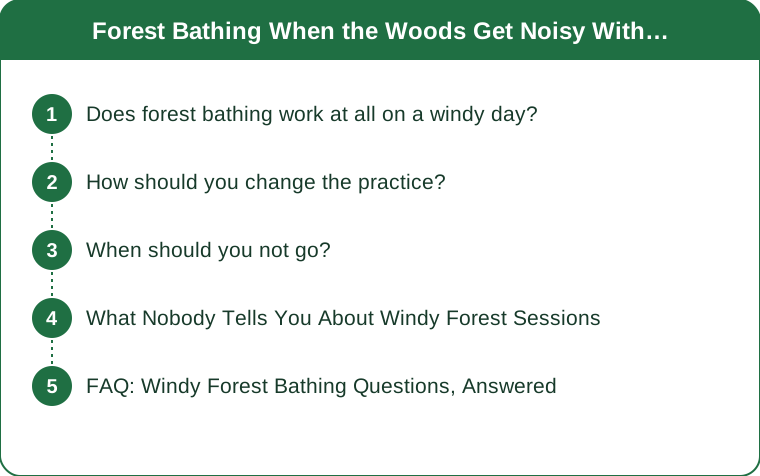
Does forest bathing work at all on a windy day?
Yes, and for some people it works better than a still day.
The proposed mechanisms behind forest bathing do not depend on silence. Time in natural environments has been associated with reductions in stress markers and improvements in mood, and the environment is doing the work regardless of how loud it is.
One frequently discussed mechanism is worth noting here: exposure to airborne compounds released by trees, sometimes called phytoncides. Wind moves air, which means a windy day disperses those compounds through the space rather than leaving them concentrated in still pockets - a plausible argument in either direction, and nobody should overstate it.
What is more clearly relevant is attention. Forest bathing works partly through what is described as soft fascination - the quality natural environments have of holding attention gently without demanding it. Movement is very good at this. Leaves turning over, branches swaying, light shifting as the canopy moves - all of it holds attention effortlessly.
And there is a group of people for whom the still version does not work. Silence can be uncomfortable if your mind fills it, and quiet woodland can amplify rumination rather than reducing it. A loud wood gives the mind something external to rest on, which is the whole point.
So the honest answer: different, not worse. Worth trying deliberately rather than treating as a compromise.
How should you change the practice?
Change the anchor, change the location, shorten the time.
Make the wind the anchor rather than something to hear past. The standard instruction to listen for distant quiet sounds does not work today. Instead:
- Listen for the wind’s rhythm - it comes in waves rather than continuously. Following the build and fall of each gust is a genuinely absorbing practice
- Notice how different trees sound different. Conifers hiss, broadleaves rattle, dry autumn leaves are louder than green ones. A mixed wood in wind is unexpectedly rich
- Watch movement rather than looking for stillness. Canopy motion, leaves crossing the light, grass laying flat and rising
Change where you go. An exposed ridge is loud, cold and unpleasant. A valley bottom or a dense stand of conifers is dramatically more sheltered, and you can still hear the wind above you while standing in relative calm - which is one of the more striking experiences available in autumn woodland.
Shorten the session. Twenty minutes in wind is more than enough, where you might have done forty on a still day. Cold and wind fatigue accumulate faster than you expect while standing still.
Keep moving more than usual. The classic instruction to find a spot and remain still does not work well in cold wind. A slow walking version keeps you warm enough to stay present.
And dress for standing still, not for walking. This is the most common practical mistake - forest bathing involves very little exertion, so you need considerably more insulation than a walk of the same duration.

When should you not go?
High winds in woodland are a genuine hazard and this is the one part of this article that is not about experience.
Falling branches and falling trees are a real risk in strong winds, and woodland is exactly where that risk concentrates. Many forestry organisations and parks close woodland access during high wind warnings, and they do so for good reason.
Clear reasons not to go:
- Any official wind warning for your area
- Woodland closure notices, which are posted for exactly this reason
- Visibly moving large branches or audible cracking
- Recently felled or storm-damaged woodland, where remaining trees are less stable
- Standing dead trees, which are the highest risk and are often obvious once you look
If you are already out and conditions worsen: move out of the woodland rather than sheltering under it. Open ground away from trees is safer than any position inside the canopy.
Lower-risk alternatives on genuinely windy days:
- Woodland edges rather than the interior
- Young plantations, where trees are smaller and branches are lighter
- Open parkland with scattered mature trees, keeping distance from any individual one
- A sheltered valley with a mixed young canopy
And a note on judgement: the day a session feels dramatic is often the day the risk is highest. The wind that makes the practice interesting and the wind that brings branches down are not far apart, and it is worth being conservative about the boundary.
What Nobody Tells You About Windy Forest Sessions
Five things that come up once you try it a few times.
Wind makes a wood smell different, and much more strongly. Air movement lifts scent from leaf litter, soil and bark in a way still air does not. Autumn woodland in wind is one of the strongest scent experiences available outdoors, and it is the sense most worth using on a day when hearing is dominated.
You hear the shape of the landscape. Wind reveals topography acoustically - you hear it arrive, pass over, and drop away in the lee. Standing in a sheltered hollow while the canopy roars above you is a distinctly autumn experience and it is not available on a calm day.
Different species genuinely sound different, and you can learn them. Pine hisses, beech rattles, oak is deeper and slower. After a few sessions you can identify what is around you with your eyes closed, which is an absorbing practice in itself.
Cold arrives much faster when standing still. Wind chill while stationary is a completely different proposition from wind chill while walking. Most people underdress for this by a full layer, and the session ends early because of cold rather than because it was finished.
Silence is not the active ingredient. This is the reframe worth taking away. The benefit is associated with being in the environment and attending to it, not with the environment being quiet. A loud wood is still a wood, and for anyone who finds silence uncomfortable, it may be the more useful version.
FAQ: Windy Forest Bathing Questions, Answered
Is it safe to be in woodland on a windy day?
In moderate wind, generally yes with sensible location choice. In high winds or during an official warning, no - falling branches are a genuine hazard and woodland is where that risk concentrates. Check for closure notices and avoid standing dead trees.
Does wind reduce the benefits?
There is no good reason to think so, and for some people it improves the experience. The benefits are associated with being in and attending to the environment rather than with silence, and movement holds attention well.
Where should I go when it is windy?
Valley bottoms, dense conifer stands and woodland edges are far more sheltered than exposed ridges or open canopy. Standing somewhere calm while hearing wind above you is one of the better autumn experiences.
How long should a windy session be?
Around twenty minutes rather than the forty you might do on a still day. Cold and wind fatigue accumulate quickly while standing still, and a shorter session you finish well beats a long one you abandon.
What should I wear?
More than you would for a walk of the same length - forest bathing involves almost no exertion, so you generate very little heat. A windproof outer layer matters more than extra insulation, and a hat makes a disproportionate difference.
What if I cannot hear anything except wind?
Use the wind as the anchor rather than trying to hear past it. Follow the wave pattern of gusts, notice how different trees sound, and lean on scent and sight, which are both heightened on windy autumn days.
TL;DR:
- Silence is not the active ingredient - being in and attending to the environment is
- Use the wind as the anchor: follow the wave pattern of gusts and notice how different species sound
- Valley bottoms and dense conifer stands are far more sheltered than ridges and open canopy
- Shorten to about twenty minutes and keep moving slowly rather than standing still
- Dress for standing still, not walking - most people underdress by a full layer
- Scent is much stronger in wind and is the sense worth using on a loud day
- Do not go in high winds or during a warning; avoid standing dead trees and storm-damaged woodland
A loud wood is still a wood. For anyone who finds silence uncomfortable, it might be the better one.
Keep Reading
This article is for general informational purposes only and is not medical advice. Always consult a qualified health professional for guidance specific to you.