Early Autumn Changes What Forest Bathing Feels Like
Quick Answer: Autumn changes forest bathing in specific ways: the soundscape empties out as birds migrate and insects die back, scent shifts from green and floral to earthy decay, light angles lower and turns everything warmer, and temperature makes stillness harder to sustain. Shorten sessions, dress for standing rather than walking, and lead with scent and sound rather than sight — the visual spectacle is distracting in a practice that is not about looking.
The practice that felt effortless in July feels strangely difficult in October. You go to the same place, do the same thing, and find your attention will not settle.
The forest changed. It makes sense that the practice has to.
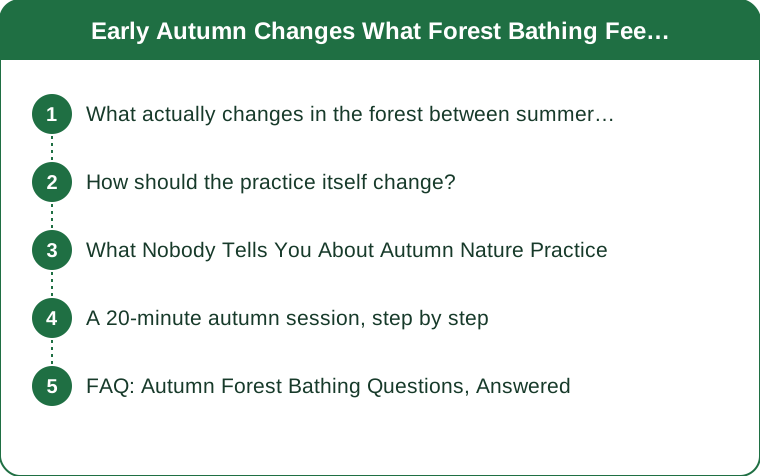
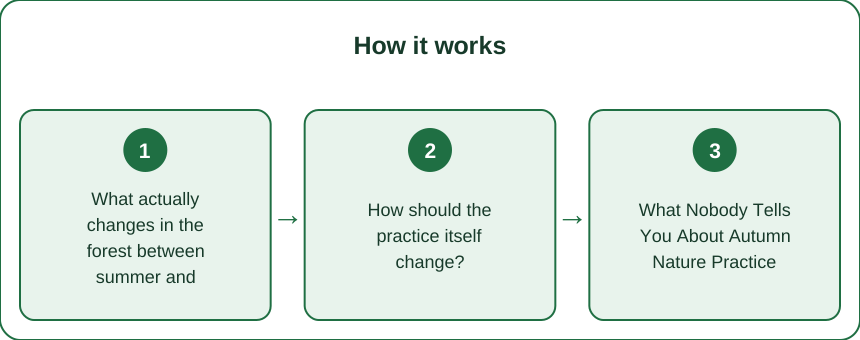
What actually changes in the forest between summer and autumn?
Four sensory channels, all shifting at once.
Sound empties out. This is the biggest change and the least anticipated. Summer forests are loud — birdsong, insects, wind through full leaves. By mid-autumn, migratory birds have left, insect noise has largely ended, and bare or thinning canopy produces a completely different wind sound.
What remains is more intermittent and more distinct. A single bird call carries further in a quiet forest, and the crunch of your own steps on leaves becomes the dominant sound. Many people find autumn forests unsettling at first for exactly this reason — the sonic background they were resting against has gone.
Scent shifts from green to earthy. Summer forest scent is dominated by living plant compounds. Autumn scent is dominated by decomposition — leaf litter, damp soil, fungi. It is a richer and more complex smell, and it is the sensory channel that changes most in a way people find pleasant.
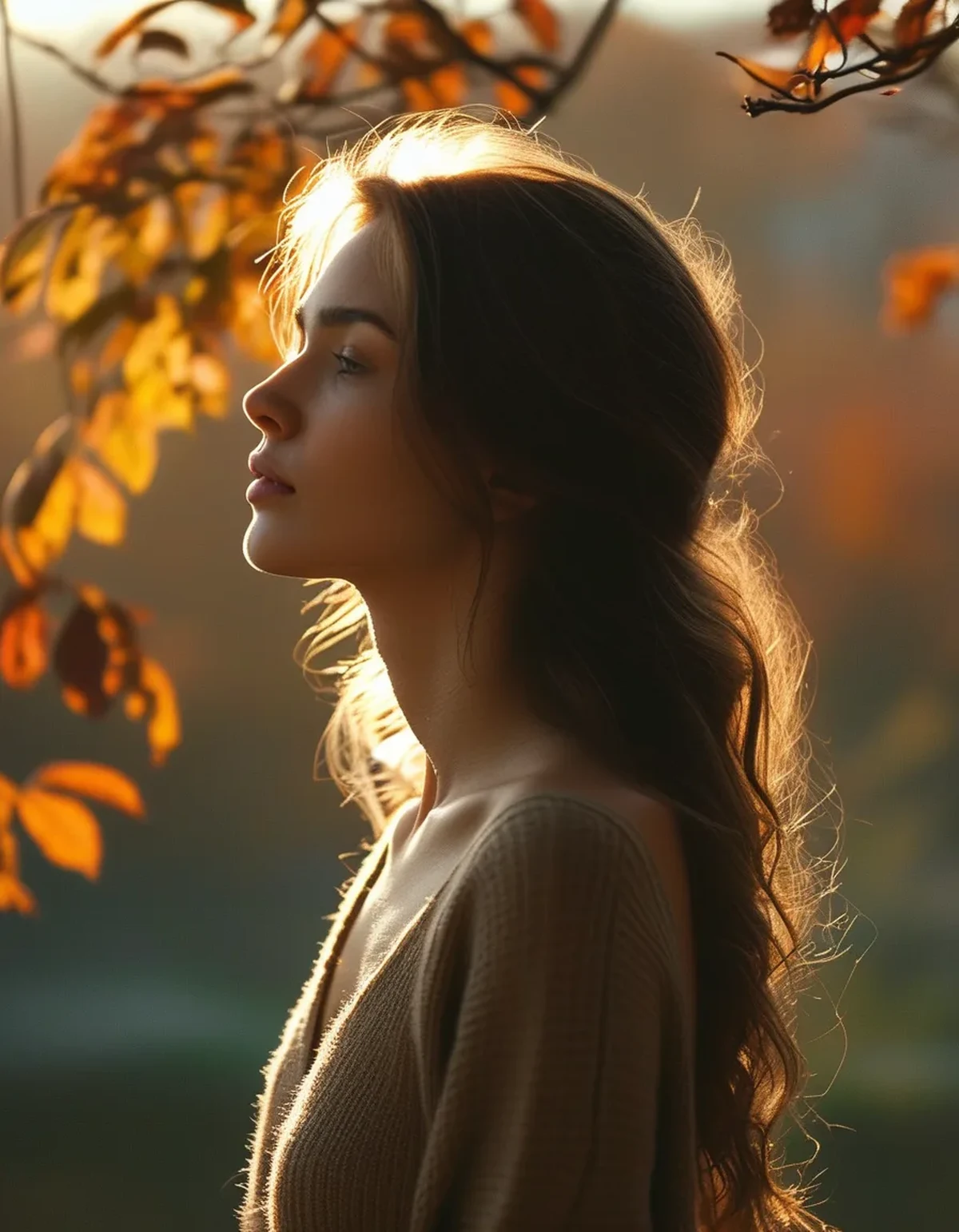
Light changes angle and color. The sun sits lower, which means longer shadows, more sidelight through the trunks, and a warmer color temperature throughout the day. Light that had to be caught at dawn in July is available all afternoon in October.
Temperature makes stillness harder. Standing still for twenty minutes at 75°F is comfortable. At 50°F it is a test of clothing. This is the practical change that ends most people’s autumn practice, and it is entirely solvable.
How should the practice itself change?
Shorten the sessions and accept it. A 40-minute summer practice becomes a 20-minute autumn practice, and 20 focused minutes in a cold forest is worth more than 40 distracted ones. The research on nature exposure suggests meaningful benefit from relatively short durations, and there is no reason to treat length as a measure of quality.
Lead with scent. Autumn’s most distinctive sensory offering is smell, and it is the channel most people use least. Stop, close your eyes, and breathe deliberately through the nose for a full minute. Damp leaf litter after rain is the single richest scent experience the year offers, and it is available for about six weeks.
Then lead with sound. In a quieter forest, individual sounds become distinct enough to attend to properly. Try counting distinct sounds rather than listening generally — most people find four or five in a summer forest and, surprisingly, a similar number in autumn, but far more separable.
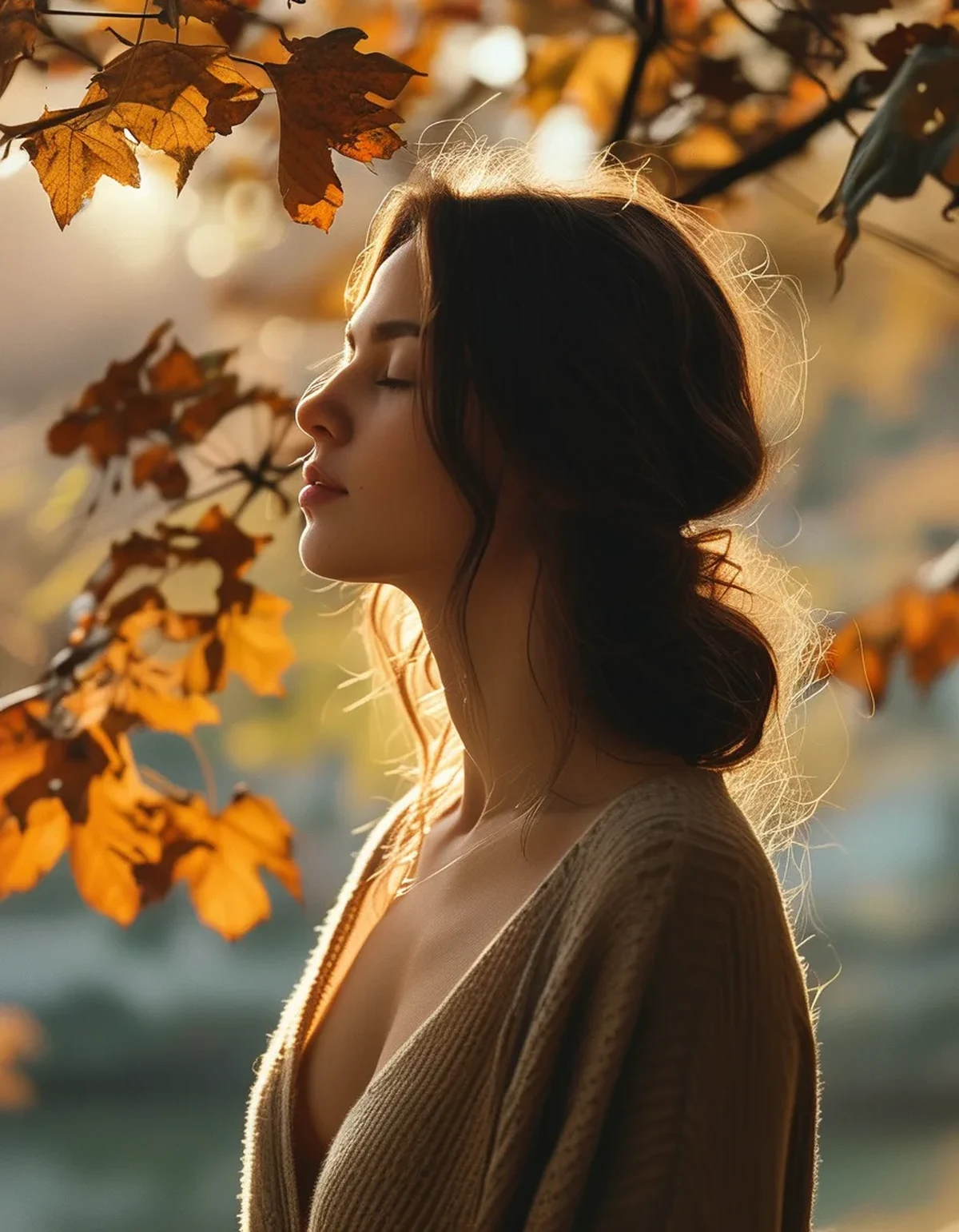
Downplay sight, deliberately. This is counterintuitive during peak color. Autumn foliage is genuinely beautiful and beauty is a distraction in this practice — it pulls you toward looking, evaluating, and photographing, which is nearly the opposite of what forest bathing does. Spend the first ten minutes with your visual attention deliberately soft or your eyes closed.
Add touch, which autumn improves. Bark texture, cool stone, the specific feeling of dry leaves versus damp ones. Cooler temperatures make tactile sensation more distinct rather than less.
What Nobody Tells You About Autumn Nature Practice
Dress for standing, not for walking. This is the single most important practical adjustment and almost every guide omits it. Forest bathing involves long periods of near-stillness, and the clothing that keeps you comfortable on a brisk autumn hike will leave you cold within ten minutes of stopping.
Add one more layer than you think you need. Bring something to sit on that insulates — the ground pulls heat out of you far faster than the air does. Gloves and a hat matter disproportionately, because still hands and an exposed head are what end sessions early.
The forest gets quieter in a way that can feel lonely. Several people describe a mild unease in late autumn forests that they do not feel in summer. It is worth naming because it passes — the discomfort is unfamiliarity with the silence rather than anything about the place.
Light disappears faster than you plan for. Sunset moves earlier by roughly a minute a day through autumn, and forest interiors go dark well before open ground does. Check sunset time and leave 45 minutes of margin, particularly for unfamiliar locations.
Mushrooms are the autumn discovery. Fungi fruit heavily in cool damp conditions, and they are one of the most rewarding things to notice slowly. Look, photograph if you like, but do not touch or eat anything you cannot identify with certainty — identification is genuinely difficult and the consequences of error are severe.
Ticks are still active. Tick activity does not stop with the first cool weather and in many regions extends well into late autumn. Check yourself after sessions.
Rain is an asset here. Damp conditions amplify forest scent enormously and quiet the ambient noise further. A light drizzle is close to ideal conditions for autumn forest bathing, provided you are dressed for it.
A 20-minute autumn session, step by step
Minutes 0–3: Arrive and stop moving. Walk in only as far as you need to be away from road noise. Then stand still. Do not choose a spot carefully — anywhere with trees around you works, and spot-hunting is a way of postponing the practice.
Minutes 3–6: Breath and scent. Eyes closed. Slow breathing through the nose. Notice what the air smells like and let the description form on its own rather than reaching for words. This is the anchor of an autumn session.
Minutes 6–11: Sound inventory. Still eyes closed, or with a soft downward gaze. Count distinct sounds. When you reach the end, start again — the second pass almost always finds sounds the first one missed.
Minutes 11–15: Touch. Move slowly to a tree. Bark, moss, a leaf, the ground. Cool textures are more distinct than warm ones and this is autumn’s advantage.
Minutes 15–19: Open sight, slowly. Now look — but at one thing at a time and for longer than is comfortable. A single leaf, a patch of ground, the way light moves through a gap. The instruction is to look at less, for longer, which is the opposite of how people usually experience autumn color.
Minute 19–20: Notice the transition. Before you leave, notice how you feel compared to when you arrived. Not to evaluate it — just to register it. This is what makes the practice cumulative rather than a series of unconnected walks.
FAQ: Autumn Forest Bathing Questions, Answered
Is peak foliage season a good time to start, or too distracting?
Both. It is the easiest time to get yourself out there and the hardest time to practice properly. If you start during peak color, spend the first half of each session with soft or closed eyes.
How cold is too cold?
There is no fixed threshold — it depends entirely on your clothing and whether you have something insulating to sit on. Most people can practice comfortably well below freezing with the right layers and cannot manage 50°F without them.
Does an urban park work in autumn?
Yes. Research on nature exposure generally finds benefit from urban green space as well as wild forest. Autumn arguably favors city parks, since a smaller area holds attention better when the sensory environment is richer.
What if I only have ten minutes?
Ten minutes is worth doing. Use the scent and sound portions and skip the rest — those are the two channels autumn does best.
TL;DR: Autumn changes the forest’s sensory palette, so change the practice to match.
- Sound empties out as birds migrate and insects die back. Individual sounds become distinct rather than blended.
- Scent becomes the richest channel — damp leaf litter and soil. Lead with it.
- Downplay sight during peak color. Beauty pulls you toward looking and evaluating, which is nearly the opposite of the practice.
- Dress for standing, not walking, and bring something insulating to sit on. This is what ends most autumn sessions early.
- Shorten to 20 minutes without apology. Focused and short beats long and distracted.
- Check sunset and leave 45 minutes of margin — forest interiors darken well before open ground.
Next session, spend the first three minutes with your eyes closed just breathing. Autumn’s best offering is one you cannot see.
Keep Reading
This article is for general informational purposes only and is not medical advice. Always consult a qualified health professional for guidance specific to you.