Forest Bathing: The Japanese Practice That Turns a Walk Into Medicine
In 1982, Japan’s forestry agency coined a term for something humans always knew and modernity forgot: shinrin-yoku — forest bathing, the practice of slow, sensory immersion in woods. Then researchers did something wonderful: they tested it, repeatedly, and the folk wisdom held up in the bloodwork — lower cortisol, lower blood pressure, improved mood and immune markers. Forest bathing is not hiking with incense. It is a specific, learnable practice, and your nearest park counts. Here is the science and the method.

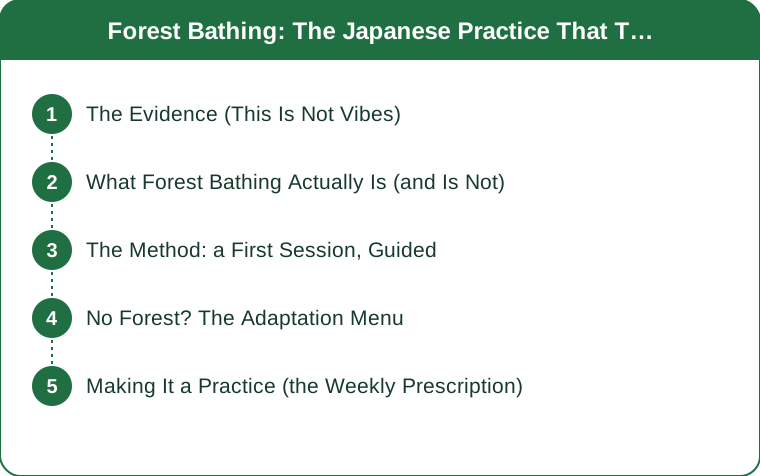
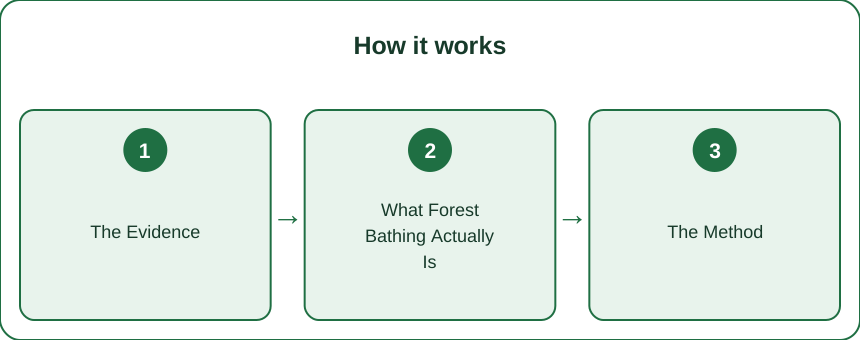
The Evidence (This Is Not Vibes)
The research base that made shinrin-yoku a public-health tool in Japan: controlled studies comparing forest walks to city walks of identical length found the forest versions produced measurably lower cortisol, blood pressure and heart rate, plus improved mood scores — replicated across dozens of trials; the immune findings are the field’s headline: forest sessions raised natural killer cell activity for days afterward, with tree-emitted compounds called phytoncides (the forest’s aromatic chemistry) as a proposed mechanism; and the broader nature-dose literature adds the famous 120-minutes-weekly threshold — total weekly nature time above two hours associates with significantly better self-reported health. The prescription pad, in short, has trees on it.
What Forest Bathing Actually Is (and Is Not)
The definitional clarity: forest bathing is slow, aimless, sensory time among trees — typically covering less than a mile in two hours (this is the anti-hike: no summit, no pace, no step count), phone silenced or abandoned, attention deliberately handed to the senses rather than the thoughts. It is not exercise (pair it with workouts elsewhere in your week; this hour has a different job), not meditation-with-scenery (eyes open, senses out — the opposite of turning inward), and not wilderness-dependent (the studies used ordinary managed forests and large parks; old-growth is a bonus, not a requirement). Think of it as sensory grazing at tree pace. The slowness is the active ingredient.

The Method: a First Session, Guided
The classic structure for your first hour: cross a threshold deliberately (pause at the trees’ edge, one slow breath, phone to silent — the small ritual that tells your nervous system the rules just changed), walk at half your normal pace for ten minutes, then half again (embarrassingly slow is correct), rotate through the senses as stations — five minutes each of listening (layers: near birds, far wind), looking (light through leaves, the fractal patterns research suggests our visual systems find inherently calming), touching (bark, moss, leaf undersides), and smelling (the phytoncide delivery system — conifers especially), then find a sit spot for twenty unhurried minutes, doing nothing with increasing skill. The fidgety first fifteen minutes are normal and part of the detox. Stay past them.
No Forest? The Adaptation Menu
The practice scales to real geography: large urban parks work (the research explicitly includes them — tree density matters more than remoteness; pick the park’s deepest grove), street-tree neighborhoods offer the slow-walk version (same pace, same senses, more squirrels than solitude), single-tree sessions are legitimate (twenty minutes under one good tree outperforms zero minutes in a mythical forest), water features add their own documented calm (blue space research parallels green), and the indoor fallbacks carry partial effects — forest soundscapes, wood interiors, even window views of trees show measurable benefits in studies. The doctrine: dose what you can access, weekly, rather than waiting for the perfect woods. Two hours of scrappy urban nature beats the pristine forest you never visit.
Making It a Practice (the Weekly Prescription)
The sustainable protocol: one anchor session weekly (60–120 minutes, calendar-protected — Sunday morning grove time is the classic slot), micro-doses between (the ten-minute lunch walk rerouted through the park’s tree section, taken at half pace with the phone pocketed — partial effects, fully worthwhile), seasonal fluency (summer’s full canopy now, but every season delivers — autumn’s color, winter’s quiet structure and negative-ion-rich cold air), and the tracking that keeps faith with the practice: note your before-and-after state for the first month (the internal data — sleep that night, the drive home’s calm — converts skeptics more reliably than any citation). Nature does not need your belief. It needs your attendance, roughly two hours a week, slowly.
Forest bathing, prescribed: slow sensory time among trees, one anchored hour or two weekly, senses rotated like stations, phone silenced, pace embarrassing — with cortisol, blood pressure and mood improvements that survived decades of measurement. Find your nearest real grove this weekend and cross the threshold at half speed. The forest has been running this clinic for millennia. Walk-ins welcome.
Keep Reading
This article is for general informational purposes only and is not medical advice. Always consult a qualified health professional for guidance specific to you.