Can Forest Bathing Actually Help With Anxiety? What the Research Suggests
Quick Answer: Research on forest bathing (shinrin-yoku) suggests it can meaningfully reduce measures of anxiety and stress-related physiological markers like cortisol levels and heart rate variability, particularly with sessions of 20 minutes or longer — it’s not a replacement for clinical anxiety treatment, but it has real, measurable supporting evidence, not just anecdotal appeal.
Forest bathing sometimes gets dismissed as vague wellness trend language, but the anxiety-related research behind it is more substantial than that framing suggests.

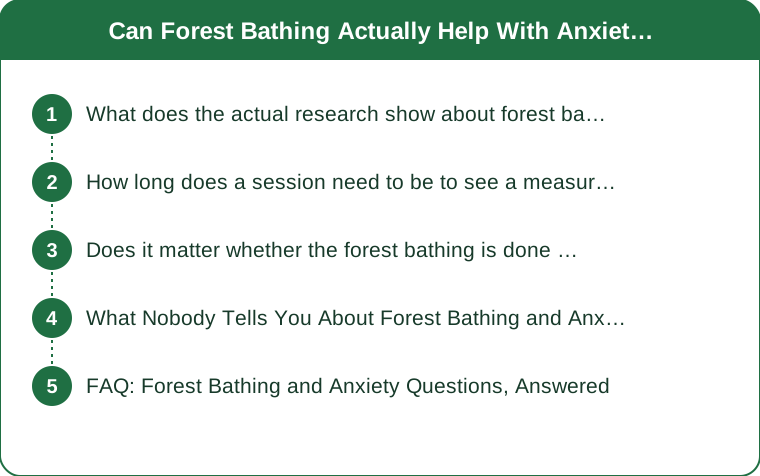
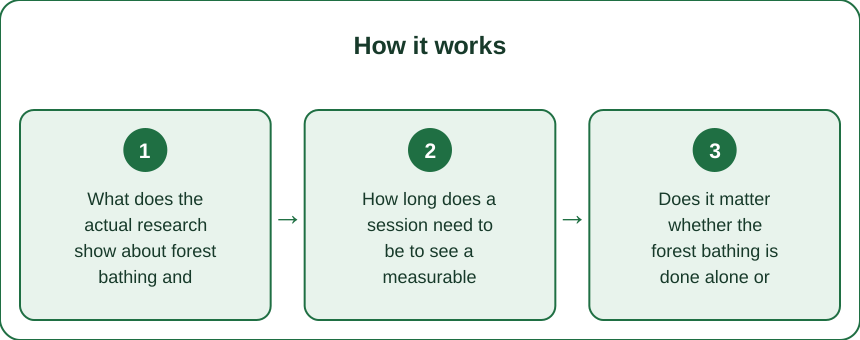
What does the actual research show about forest bathing and anxiety?
Multiple studies have found reductions in cortisol (a stress hormone), lowered heart rate, and improved self-reported mood and anxiety measures after forest bathing sessions, compared to spending similar time in urban environments. The effect appears linked to both the sensory environment (sounds, scents, visual complexity of nature) and reduced sensory overload compared to urban settings.
How long does a session need to be to see a measurable effect?
Most studies showing meaningful effects use sessions of at least 20-40 minutes, though shorter exposure still appears to provide some benefit. This is consistent with related research on nature exposure and stress more broadly — longer immersion tends to produce more pronounced physiological changes.

Does it matter whether the forest bathing is done alone or with others?
Some research suggests solo practice may allow for deeper sensory focus and stress reduction, since conversation and social interaction can compete with the calming, low-stimulation aspect of the practice — though group sessions still show benefit, particularly for people who find solo time itself anxiety-provoking.
What Nobody Tells You About Forest Bathing and Anxiety
Here’s what’s often left out of forest bathing content: the practice’s specific emphasis on slow, phone-free, unstructured sensory engagement (rather than just being outdoors) appears to matter for the anxiety-related benefits. A brisk, distracted walk while checking a phone doesn’t appear to produce the same measured stress-reduction effects as a slower, more deliberately present forest bathing session.
FAQ: Forest Bathing and Anxiety Questions, Answered
Can forest bathing replace therapy or medication for anxiety?
No — it shows real supporting evidence as a complementary practice, but it isn’t a substitute for professional treatment for clinical anxiety disorders. This is general information, not medical advice.
Does it have to be a dense forest, or can a city park work?
Research on urban green space suggests city parks can provide some similar benefit, though studies specifically on shinrin-yoku have mostly used denser forest environments — an urban alternative is still meaningfully better than no nature exposure.
How often would someone need to practice forest bathing to see lasting anxiety benefits?
Most research examines single-session effects; for lasting benefit, regular practice (weekly, if possible) is a reasonable approach, similar to how other stress-reduction practices tend to compound with consistency.
TL;DR:
- Research shows forest bathing can measurably reduce cortisol, heart rate, and self-reported anxiety
- Sessions of 20-40 minutes or longer tend to show the clearest effects
- Slow, phone-free, sensory-focused engagement appears to matter, not just being outdoors
- It’s a real, evidence-supported complementary practice, not a replacement for clinical treatment
This is general information, not medical advice — forest bathing is a reasonable addition to anxiety management, not a substitute for professional care.
Keep Reading
This article is for general informational purposes only and is not medical advice. Always consult a qualified health professional for guidance specific to you.