Forest Bathing in the Last Weeks Before the Canopy Turns
Quick Answer: Late summer is arguably the best forest bathing window of the year - the canopy is at maximum density, plant volatile compounds are at their seasonal peak in warm humid air, and the woods are quiet before autumn brings visitors. Aim for two hours of slow, unstructured time rather than a walk with a destination, and go in the early morning when air is still and birdsong is at its densest.
The practice is not a walk. Most of the benefit comes from stopping, and most people do not stop.
This is general information rather than medical advice.
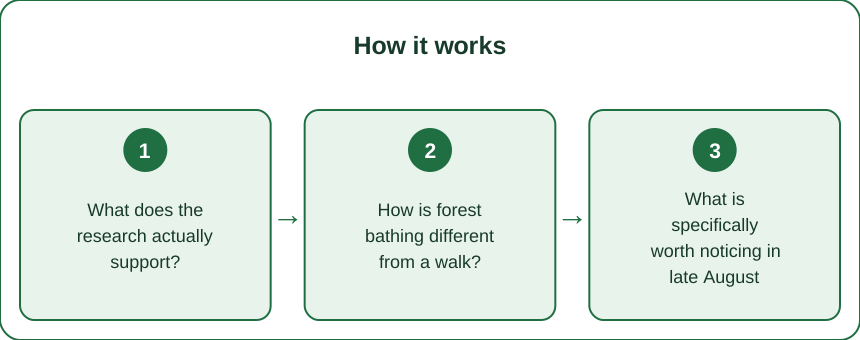
What does the research actually support?
A reasonable body of evidence for specific physiological effects, with sensible caveats.
What has been measured. Studies on shinrin-yoku - forest bathing - have reported:
- Reduced cortisol compared with matched time in urban environments
- Lower blood pressure and heart rate after forest exposure
- Increased heart rate variability, indicating a shift toward parasympathetic activity
- Improved mood scores on standard measures, with effects on anxiety and rumination
- Some evidence for increased natural killer cell activity, attributed partly to inhaled plant compounds, though this work is smaller and less replicated
The honest caveats. Many studies are small, short-term, and conducted in Japan and Korea with particular forest types. Blinding is impossible, and expectation effects cannot be excluded. The direction of the findings is consistent; the size of the effects varies considerably.
What is well established beyond forest bathing specifically. Time in green space is reliably associated with better mental health outcomes, and this is a large and robust literature independent of any particular practice.
Phytoncides, which are the specific mechanism proposed. Trees release volatile organic compounds - including terpenes such as alpha-pinene and limonene - partly as defence against insects and pathogens. These are what a coniferous forest smells like, and they are being investigated as one route by which forest air affects human physiology.
Why late summer matters for this. Volatile compound emission increases with temperature and is highest in warm conditions, and dense summer foliage means maximum emitting surface. Late August in a warm still forest is close to the annual peak for this, which is a genuine reason to go now rather than waiting for autumn colour.
How is forest bathing different from a walk?
Pace, intention and stopping - and the third is where most people fall short.
The core distinction. A walk has a destination and a pace. Forest bathing has neither. The practice is sensory immersion, and covering distance actively works against it.
The parameters that appear in the research:
- Around two hours is a common study duration, though benefits appear from shorter sessions
- Distance is typically very short - often under 2km across the whole session
- Considerable time is spent stationary
A workable structure for a late summer session:
- First 15 minutes: transition. Walk at normal pace, let the mind wind down. Do not expect anything to happen yet - this is the part people mistake for the practice not working
- Next 20 minutes: slow down deliberately. Half your normal walking speed. Notice this is uncomfortable at first
- Then: stop. Find somewhere to sit or stand and stay for 20 to 30 minutes. This is the part that does the work and the part most people skip
- Then: move slowly with attention to one sense at a time. Ten minutes on sound, ten on sight, ten on smell
- Finish sitting for a final ten minutes
Sensory prompts, which help when attention drifts:
- Sound. Count how many distinct sounds you can identify. Late summer woodland has a specific soundscape - late birdsong, insects, leaves that are drier than they were in June
- Sight. Look for the smallest thing you can see, then the furthest. Changing focal distance repeatedly is genuinely restful after weeks of screens
- Smell. Warm late summer forest smells strongest in still morning air. Crushing a leaf between your fingers releases far more
- Touch. Bark, moss, leaves. Textures vary more than expected across a few metres
On phones. Leave it in a pocket, on silent. The single most common reason a session does not work is intermittent phone checking, which resets attention each time.
What is specifically worth noticing in late August woodland?
This is a transitional fortnight with things visible now that are gone in three weeks.
The canopy at maximum.
- Leaf area is at its annual peak, which means the deepest shade and the most dramatic dappled light of the year
- The forest floor is at its darkest, and understory plants are finishing
- Sound is most muffled now, because dense foliage absorbs it. A late summer wood is measurably quieter than the same wood in November
The first signs of change, which are subtle and worth looking for:
- Early leaf colour on stressed or shallow-rooted trees, often near paths and edges
- Birch and cherry frequently turn first
- Leaves feeling drier and sounding different underfoot than they did in June
- Fruit and seed - berries, acorns forming, seed heads. This is the abundance point of the woodland year
Wildlife in this window:
- Birdsong is reduced from the spring peak but not absent. Different species, different purposes
- Fungi begin appearing, particularly after rain. Late August into September is the start of the main fungal season
- Insects are at peak abundance, which is worth noticing rather than only tolerating
Practical notes for late summer specifically:
- Go early. Morning is cooler, air is stillest, birdsong is at its densest, and there are fewer people
- Ticks are still active in warm weather. Cover ankles, check afterwards - particularly behind knees, waistband and hairline
- Biting insects peak near water and at dusk, so morning is better than evening
- Warm humid air holds scent far better than cold dry air, which is one of the underrated advantages of going now
On foraging, since this is the season for it. Never eat anything you have not identified with complete certainty, particularly fungi. Several deadly species closely resemble edible ones, and there is no general rule that distinguishes them.
What Nobody Tells You About Forest Bathing
The first twenty minutes usually feel like nothing. People conclude it does not work and leave. The shift in attention takes time, and most studies use sessions long enough for that to happen. Twenty minutes of restlessness is the normal beginning, not a failure.
Boredom is part of it. A mind used to constant input finds unstructured slow time uncomfortable. That discomfort is the thing being addressed, not an obstacle to it - which is a difficult reframe and the one that makes the practice work.
You do not need an impressive forest. Studies have found effects in ordinary urban woodland and city parks. A small local wood you visit weekly is worth considerably more than a spectacular one you visit twice a year, and the accessibility is the point.
Stopping matters more than walking. The seated or standing portion is where most of the physiological shift happens. Most people walk the whole time, which turns the practice into a slow walk - pleasant, but not the same thing.
Weather that seems bad is often better. Light rain suppresses other visitors, intensifies forest scent, and changes the soundscape entirely. Overcast still days are frequently the best conditions, which is the opposite of what people plan for.
The effect on sleep is often the most noticeable outcome. People report better sleep on the night after a session more consistently than they report feeling different at the time. Which means judging a session by how it felt during it undersells it.
FAQ: Late Summer Forest Bathing, Answered
How long should a session be?
Around two hours is typical in the research, though shorter sessions show benefits. What matters more is that a substantial portion is spent stationary rather than walking.
Is late summer a good time for it?
It is one of the best. The canopy is at maximum density, plant volatile compounds peak in warm conditions, and the woods are quiet before autumn colour brings visitors.
What time of day is best?
Early morning. Air is stillest, which holds scent, birdsong is densest, temperatures are comfortable, and biting insects are less active than at dusk.
Do I need a large forest?
No. Studies have found effects in ordinary urban woodland and city parks. A small local wood visited weekly is worth more than a spectacular one visited rarely.
Why do I feel restless for the first twenty minutes?
That is normal and it is part of the process. A mind used to constant input takes time to settle, which is why sessions in the research are long enough to allow it.
What should I watch out for in late summer?
Ticks are still active - cover ankles and check afterwards, particularly behind the knees and at the hairline. And never eat any foraged fungi you have not identified with complete certainty.
TL;DR:
- Late August is close to the annual peak for forest bathing - densest canopy and highest plant volatile emission
- The practice is not a walk: cover very little distance and spend 20 to 30 minutes stationary
- The first twenty minutes feel like nothing, which is the normal beginning rather than a failure
- Go early morning for still air, dense birdsong and fewer people
- Ticks are still active - cover ankles and check afterwards
The woods are at their fullest right now and almost nobody is in them. In four weeks both of those will be untrue.
Keep Reading
This article is for general informational purposes only and is not medical advice. Always consult a qualified health professional for guidance specific to you.